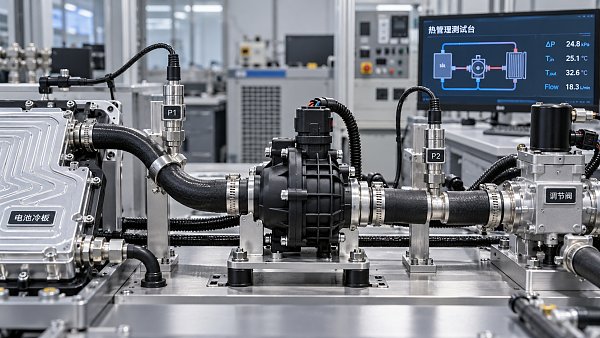
Battery Thermal Management
Navigation
Send Us A Message
How Do You Test Material Compatibility With EV Coolants?
Author
Date Published
Reading Time
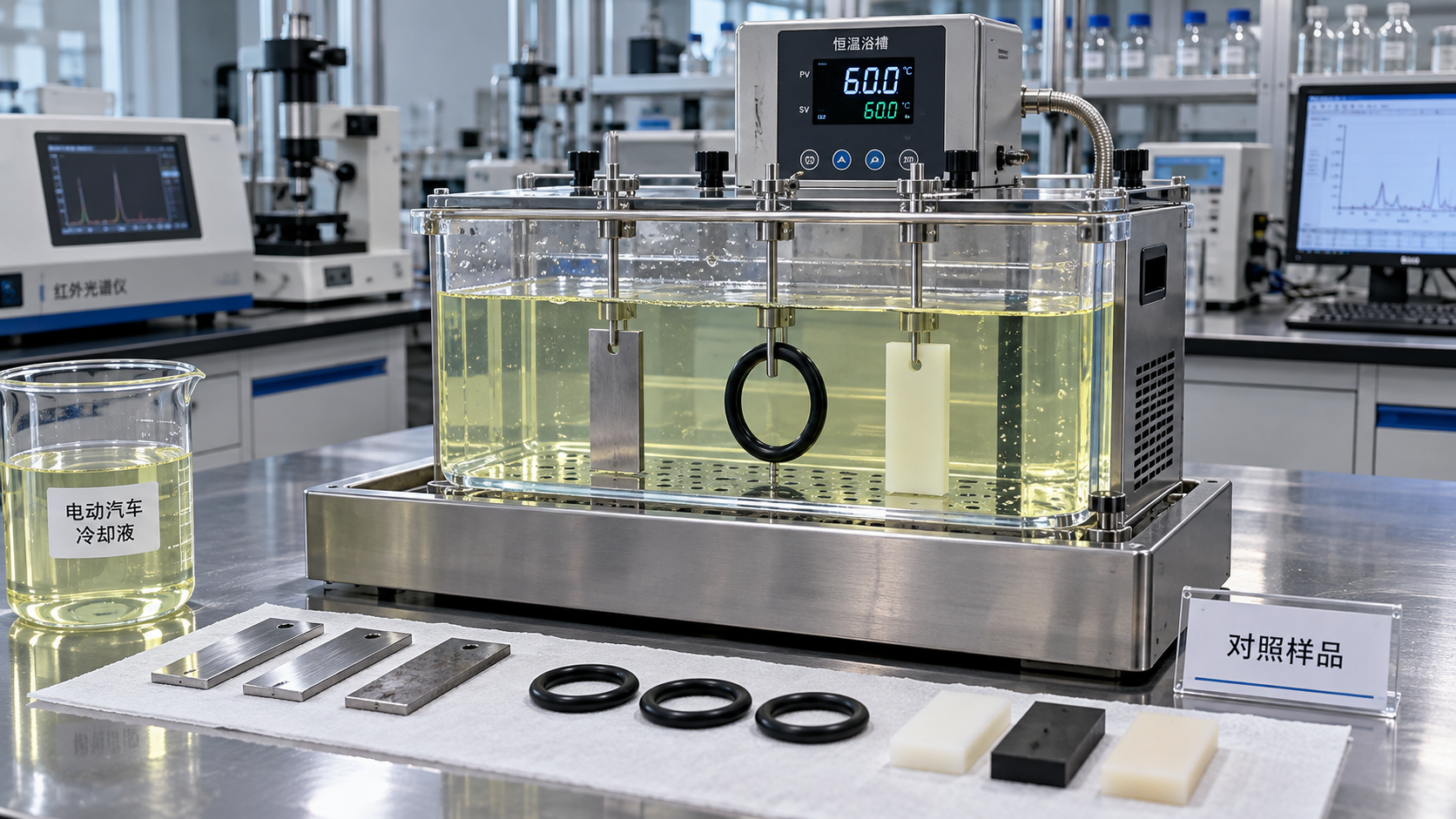
Test EV coolant material compatibility by exposing production-representative materials to the intended coolant under controlled conditions, then measuring changes in both the materials and the fluid. Immersion testing provides an initial screen, but approval also requires evidence that seals, joints, metals, and plastics retain their function under representative temperature, pressure, flow, and aging conditions.
A coolant can maintain acceptable heat-transfer properties while causing seal swelling, localized corrosion, plastic cracking, or electrical-conductivity drift. Compatibility is therefore not a property of the coolant alone: it applies to a specific combination of fluid formulation, material grade, manufacturing condition, and operating environment.
Define the exposure before choosing the test
Start with the cooling architecture. A water-glycol circuit running through battery cold plates presents different compatibility requirements from a dielectric fluid in direct contact with cells, electrical insulation, or electronic assemblies. A fluid described as suitable for EVs is not automatically suitable for both applications.
For an indirect water-glycol circuit, identify every wetted material: aluminum alloys, stainless steel, copper-containing components where present, brazing materials, coatings, elastomers, engineering plastics, adhesives, and sealants. Include small exposed features such as sensor seals and connector interfaces. Their wetted area may be limited, but their failure can disable the circuit.
For direct-contact cooling, expand the inventory to include cell sleeves, labels, potting compounds, wire insulation, adhesives, and other surfaces the fluid can reach. Electrical behavior becomes part of compatibility, not merely an additional fluid specification.
The exposure definition should establish:
- The exact coolant formulation, dilution ratio, and approved dilution-water quality.
- Normal operating temperatures, transient peaks, cold starts, and shutdown periods.
- Pressure, flow velocity, oxygen exposure, and relevant electrical conditions.
- Expected service duration, fluid replacement strategy, and credible contamination sources.
- Whether the component is continuously immersed, intermittently wetted, or exposed only during a leak.
Distinguish normal operation from misuse. An incorrect top-up fluid may justify a separate robustness test, but it should not silently become part of the normal compatibility qualification.
Use representative materials—not just generic polymer names
“EPDM,” “PA66,” or “aluminum” is insufficient identification for a qualification sample. Elastomer behavior depends on formulation and cure system. Plastic performance depends on reinforcement, additives, moisture conditioning, molding conditions, and residual stress. Metal performance depends on alloy, surface treatment, and joining processes.
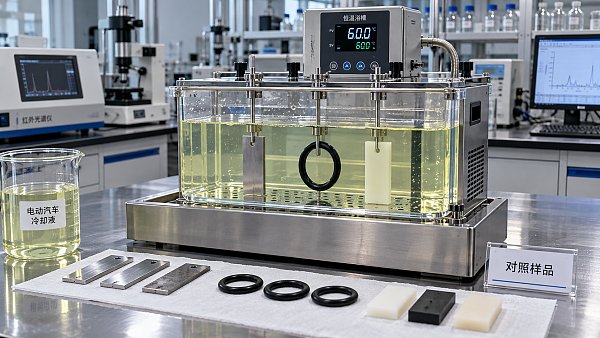
Use specimens taken from production-equivalent materials and record their grades, batches, surface finishes, and processing history. Where practical, test finished components alongside standardized coupons. A molded seal or welded plastic manifold may behave differently from a laboratory sheet of nominally similar material.
Include unexposed reference specimens and a coolant-only aging control. The reference separates exposure damage from initial material variation; the coolant-only control helps distinguish natural fluid aging from changes caused by material contact. Replicate specimens are necessary to judge variability, particularly for mechanical tests that consume the sample.
Establish baseline measurements before exposure. Record mass, dimensions or volume, appearance, and the mechanical or functional properties relevant to the part. Condition and measure specimens consistently: differences in drying, moisture uptake, or measurement temperature can obscure the effect being investigated.
Build an immersion test that produces interpretable results
Immersion testing is useful for screening material-fluid combinations and comparing candidate formulations. Its value depends on controlling more than temperature and duration.
Specify the specimen surface-area-to-fluid-volume ratio, vessel material, headspace, oxygen conditions, and whether the fluid remains static or is refreshed. A small fluid volume can accumulate extracted additives or corrosion products much faster than a vehicle circuit. Uncontrolled evaporation can change glycol concentration and inhibitor levels, creating a different exposure from the one intended.
Use equipment suitable for the selected fluid, temperature, and pressure. A heated open vessel does not reproduce a pressurized coolant circuit, while a sealed vessel can develop pressure and alter oxygen availability. Neither arrangement should be selected without considering the intended degradation mechanism and laboratory safety requirements.
Separate exposures help identify which material releases contaminants. Mixed-material exposures can then reveal interactions, including inhibitor consumption and galvanic effects. For galvanic testing, reproduce relevant electrical contact and exposed-area ratios; simply placing two disconnected metals in the same container does not reproduce a coupled assembly.
Test at representative operating conditions and use elevated-temperature exposures where technically justified. Higher temperature can accelerate degradation, but excessive temperature may introduce mechanisms that do not occur in service. Do not convert an accelerated soak into a vehicle-life claim without a validated aging relationship.
Use intermediate inspection points rather than relying only on the final condition. Swelling may approach equilibrium, while embrittlement or corrosion can continue to develop. Time-dependent results help distinguish an initial adjustment from progressive damage.
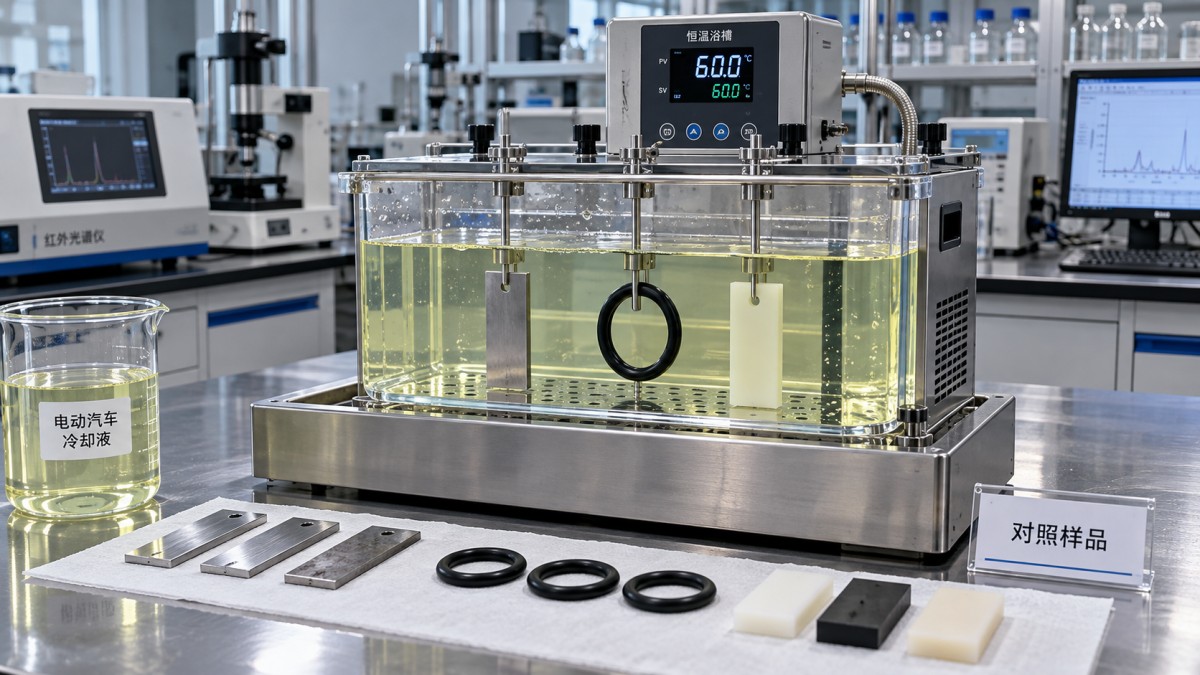
Measure damage according to how the component can fail
Visual inspection is necessary but cannot establish compatibility on its own. A specimen can look unchanged while losing strength, and a metal coupon can show little total mass loss despite localized penetration.
Elastomers: connect swelling to sealing performance
Volume change alone is not a sufficient pass criterion. Swelling can increase contact pressure initially but also overfill a seal gland or reduce mechanical strength. Shrinkage can reduce sealing contact. Hardness changes and extraction of formulation ingredients may alter long-term behavior even when dimensions remain acceptable.
ASTM D471 provides methods for evaluating the effect of liquids on rubber. Use its applicable procedures as a measurement framework, then connect the results to the actual seal design. Test aged seals in representative glands where sealing-force retention, assembly tolerances, and compression influence leakage.
Define the interval between removal from the fluid and measurement. Some changes partially reverse as absorbed fluid leaves the specimen. Measuring every specimen after an uncontrolled recovery period can hide the condition present during operation.
Plastics: add stress to the exposure
An unstressed plastic coupon may survive immersion while a pressurized or tightly assembled component cracks. Residual molding stress, weld lines, threaded connections, and mechanical preload can change the outcome.
ASTM D543 provides practices for evaluating plastics’ resistance to chemical reagents. Supplement chemical exposure testing with appropriately strained specimens or loaded components when stress-assisted cracking is credible. For moisture-sensitive polymers, control initial conditioning and interpret fluid uptake separately from irreversible chemical degradation.
Metals: look beyond average corrosion
Measure mass loss using a defined cleaning procedure, but also inspect for pitting, crevice corrosion, and attack at brazed or welded regions. Cleaning must remove corrosion products without introducing unaccounted base-metal loss.
ASTM D1384 provides a glassware corrosion test for engine coolants, while ASTM D2570 addresses simulated-service corrosion testing. These can supply useful evidence for aqueous coolant assessment, but neither automatically qualifies an EV circuit with different materials, temperatures, geometry, or electrical requirements. Confirm the applicable method edition and any customer-specific modifications.
Analyze what the materials do to the coolant
Compatibility is bidirectional. A material may retain its strength while releasing ions, plasticizers, or other substances that change fluid behavior. Corrosion products can also circulate into narrow passages or accumulate on heat-transfer surfaces.
For water-glycol fluids, relevant measurements can include pH, glycol concentration, electrical conductivity, inhibitor condition, dissolved metals, turbidity, and sediment. Select analytical methods according to the coolant chemistry and suspected mechanism rather than applying every available test indiscriminately.
Measure conductivity at a defined temperature. A rise can indicate ionic contamination or chemical change, but conductivity alone does not identify the source. Interpret it alongside chemical analysis and the electrical requirements of the circuit.
For dielectric fluids, assess the electrical properties required by the application, potentially including resistivity and dielectric breakdown performance, together with moisture and degradation indicators appropriate to the chemistry. Fresh-fluid electrical data cannot establish performance after prolonged contact with production materials.
Compare exposed fluid with both its initial condition and the aged coolant-only control. This comparison is essential when deciding whether an observed change comes from thermal aging, material extraction, corrosion, or a combination of mechanisms.
Confirm the screened combination in a representative circuit
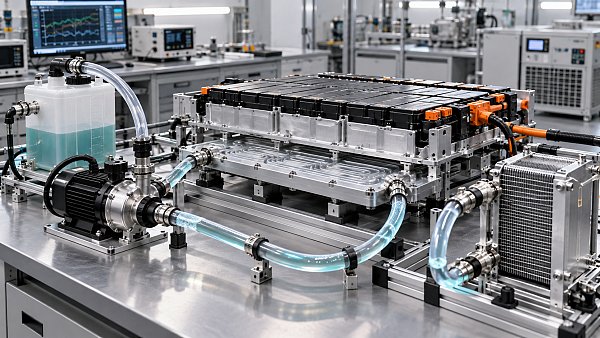
Static immersion cannot reproduce all the conditions that determine field reliability. After screening, use component or loop testing to expose the selected combination to circulation, pressure cycling, thermal cycling, and representative joints.
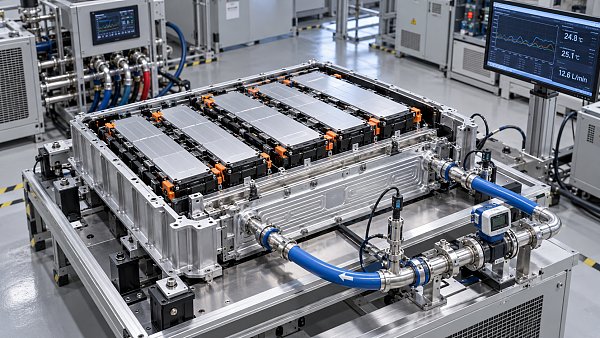
The loop should include critical production features: cold-plate passages, pump seals, hose connections, manifolds, valves, and sensors as applicable. Control flow, pressure, fluid volume, air management, and filtration. A laboratory filter that continuously removes debris can conceal a contamination problem if the vehicle has no equivalent filtration.
Monitor leakage, pressure drop, flow, pump behavior, and heat-transfer performance as well as fluid chemistry. Deposit formation may impair cooling before bulk fluid measurements exceed their limits. Inspect dismantled components after testing, including crevices and low-flow regions that external inspection cannot reveal.
Where credible, include separately defined challenges involving aged coolant, approved service-fluid mixtures, dilution-water variation, or manufacturing residues. Fresh coolant testing alone does not establish compatibility with a depleted inhibitor package. However, artificially aged fluid must be characterized: aging it aggressively without understanding the resulting chemistry may create an irrelevant test medium.
Set acceptance criteria before reviewing the results
There is no universal allowable swelling percentage, corrosion rate, or strength loss that qualifies every EV cooling component. Acceptance limits must come from functional requirements, material behavior, dimensional tolerances, and the consequences of failure.
A seal needs adequate contact force across its tolerance range. A plastic housing needs sufficient retained strength for pressure and assembly loads. A thin-wall heat exchanger needs protection against localized penetration, not merely a low average corrosion rate. The coolant must remain within the chemical and electrical limits specified for its architecture.
Define these limits before testing and evaluate trends as well as endpoint values. A result within limits but still deteriorating rapidly at the final inspection requires a different judgment from a stable result with demonstrated margin.
A defensible approval record identifies the exact fluid formulation, material grades, specimen preparation, exposure conditions, methods, deviations, replicate results, and post-test findings. Supplier statements that a material is “glycol compatible” do not replace this evidence. Changes to coolant additives, elastomer compounds, plastic grades, coatings, or joining processes should trigger a documented review of whether existing qualification remains applicable.
The release decision should therefore identify the qualified material-fluid combination and its operating boundaries—not simply label either the coolant or the material as compatible.
Core Sector // 01
Recommended News
 Battery Thermal ManagementHow Accurate Do EV Battery Temperature Sensors Need to Be?Battery temperature sensor accuracy goes beyond datasheet tolerance. Discover how placement, response time, and error budgets help you specify the right EV sensors and optimize BMS performance.
 Battery Thermal ManagementHow Do You Test Material Compatibility With EV Coolants?EV coolant material compatibility testing helps prevent leaks, corrosion, and cracking. Learn how to evaluate materials, analyze fluid changes, and validate reliable cooling performance.
 Battery Thermal ManagementHow to choose automotive coolants for an EV battery cooling loopChoose Automotive Coolants for EV battery cooling loops with confidence. Compare heat transfer, conductivity, material compatibility, and OEM requirements to find the right fluid.
 Battery Thermal ManagementHow Do You Calculate EV Battery Cooling Load?EV battery cooling load calculation explained: learn key formulas, follow a worked example, and estimate coolant flow to make informed battery thermal management decisions.
 Battery Thermal ManagementDoes Global Automotive Systems & Components Portal Distinguish Prototype and Production Battery Cooling Plates?Does Global Automotive Systems & Components Portal distinguish battery cooling plate prototypes from series production? Explore GASC’s readiness insights for smarter sourcing decisions.
 Battery Thermal ManagementChoosing a leak test method for battery cooling plate productionBattery Cooling Plates need reliable leak testing. Compare pressure decay, differential pressure, and tracer gas to reduce false rejects and select the right method for your production line.
 Battery Thermal ManagementHow battery thermal management systems limit fast-charging hot spotsBattery Thermal Management Systems limit fast-charging hot spots through targeted cooling and smart controls. Discover how to evaluate thermal safety and sustained charging performance.
 Battery Thermal ManagementHow battery cooling plate channel design affects pressure dropBattery Cooling Plates: Learn how channel depth, bends, and flow paths affect pressure drop. Discover how to balance cooling performance and pump power for smarter plate selection.
 Battery Thermal ManagementSizing automotive electric coolant pumps for system pressure dropSize Automotive Electric Coolant Pumps to match system pressure drop, flow demand, and electrical limits. Discover practical checks to avoid oversizing and ensure reliable vehicle cooling.