Steering Actuation & Control
Navigation
Send Us A Message
Why Does a Steering Universal Joint Bind Only at High Temperatures?
Author
Date Published
Reading Time
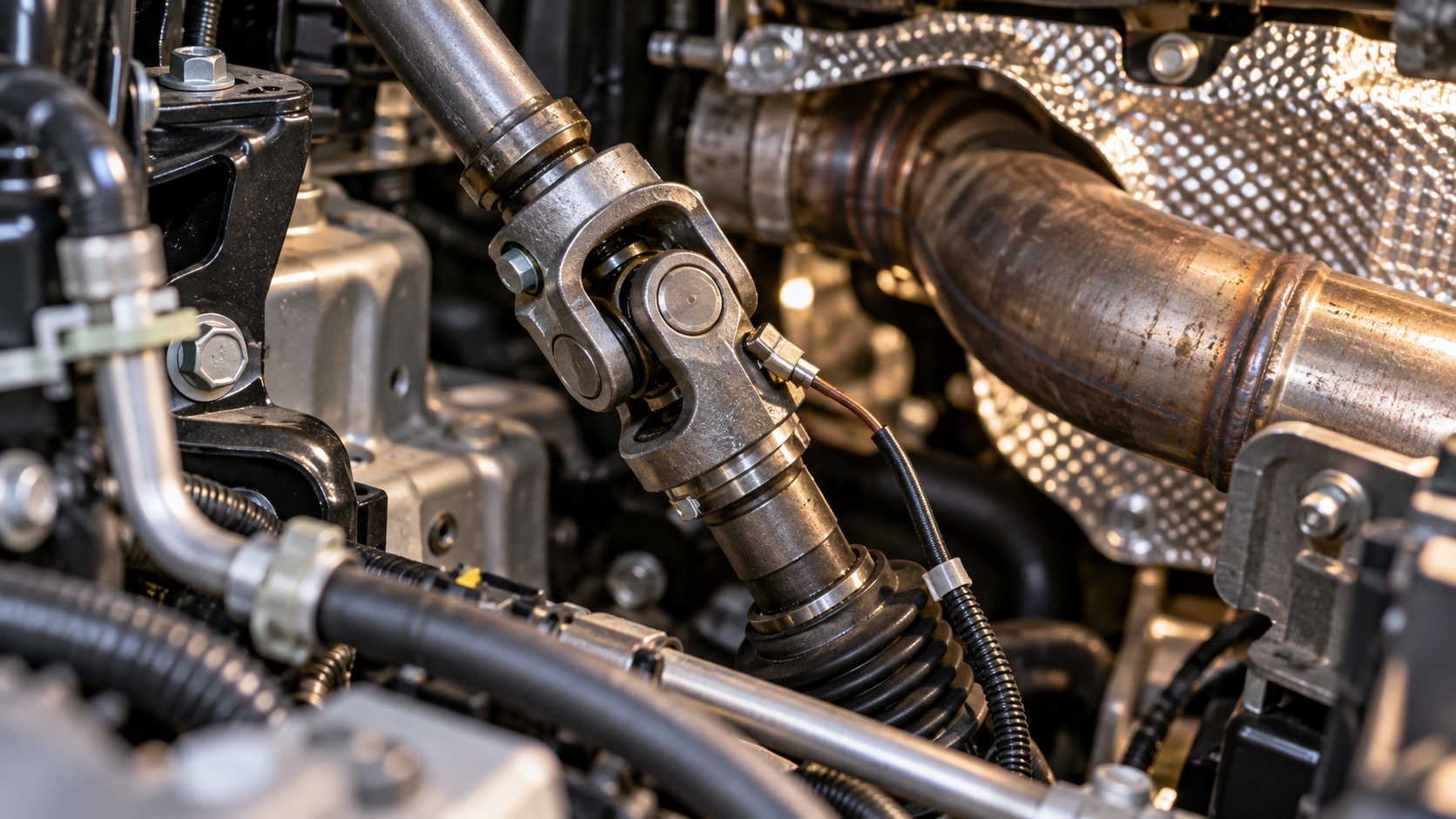
A steering system can feel normal during a cold inspection, then develop a tight spot after a long drive or a short stop with a hot engine. By the time the vehicle reaches a workshop, the symptom may have disappeared. That inconsistency makes temperature-dependent steering complaints frustrating—and makes a cold-only inspection unreliable.
Why does a steering universal joint bind only at high temperatures? Heat can expose marginal bearing clearances, degraded lubrication, seal interference, or installation stresses that are not obvious when cold. However, hot steering stiffness does not automatically prove the joint is faulty. The steering column, intermediate shaft, rack, and power-assist system can produce similar symptoms.
The useful diagnostic question is therefore not simply whether the joint gets hot, but what changes as it heats up, and where the additional steering resistance originates.
What changes inside a steering universal joint when it gets hot?
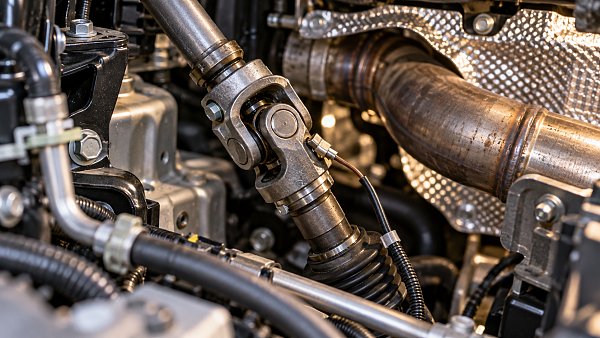
A steering universal joint transfers rotation between shafts operating at an angle. Many designs use a cross supported by needle bearings in bearing cups. Smooth articulation depends on bearing condition, internal clearance, lubrication, sealing, and correct installation.
Temperature affects all of these, but not necessarily in the same direction.
Thermal expansion can change an already marginal fit
The cross, bearing cups, needles, and yokes expand as their temperatures rise. Whether effective bearing clearance increases or decreases depends on their materials, geometry, constraints, and temperature differences. It is inaccurate to say that heat always makes a universal joint tighter.
Binding becomes plausible when an assembly already has little operating margin—for example, because of cup distortion, excessive assembly preload, dimensional variation, or previous damage. Uneven heating can further change the relationship between parts. A joint near an exhaust component may experience a substantially different thermal environment from the upper shaft.
Lubrication may become inadequate rather than simply “too thick”
Grease does not normally become thicker just because it gets hot; its base oil generally becomes less viscous. Nevertheless, elevated temperature can expose lubrication problems. A damaged bearing may lose adequate lubricant-film protection as viscosity falls, while prolonged thermal exposure can promote oxidation, oil loss, and deposits.
Old or unsuitable grease may no longer lubricate the needle contacts effectively. The relevant questions are whether the correct lubricant remains in the bearing, whether it has deteriorated, and whether contamination or surface damage has increased friction.
Seals and existing corrosion can add resistance
Depending on their material and condition, seals may change stiffness or dimensions with temperature. Chemical swelling from incompatible fluids or lubricants can also increase interference. These effects are design-specific and should not be assumed without inspection.
Corrosion is another common contributor. A sealed-looking joint can still admit moisture after seal damage or aging. Rusted needles or pitted races may articulate when cold yet become noticeably rougher under hot operating conditions. Heat usually exposes an existing weakness; it does not create significant corrosion during a single drive.
Could the shaft installation be responsible instead of the bearings?
Yes. A joint that moves freely on the bench can bind in the vehicle if its installed geometry or loading is wrong.
The intermediate shaft must accommodate the specified alignment, operating angles, and axial movement. Incorrect shaft length, improper seating, a damaged sliding section, displaced mounts, or collision-related distortion can impose loads that the universal joint was not intended to carry.
Thermal expansion elsewhere in the vehicle may then increase those loads. Where applicable, powertrain movement relative to the body can also change the shaft’s operating conditions. A marginal cold installation can become restrictive after warm-up.
- Excessive operating angle: Articulation may approach a mechanical limit, especially if brackets or mounts have moved.
- Restricted axial movement: A seized or incorrectly assembled telescoping section can transmit axial force through the steering shaft.
- Incorrect joint phasing: On applicable multi-joint arrangements, incorrect orientation can create uneven rotational motion and effort variation. Phasing requirements are design-specific.
- Clamp or yoke distortion: Incorrect hardware, tightening procedure, or assembly position can compromise the connection.
- External contact: A shaft, boot, shield, or nearby component may interfere only after heating or movement.
These possibilities matter particularly when the complaint begins after steering, suspension, subframe, engine-mount, or collision repairs.
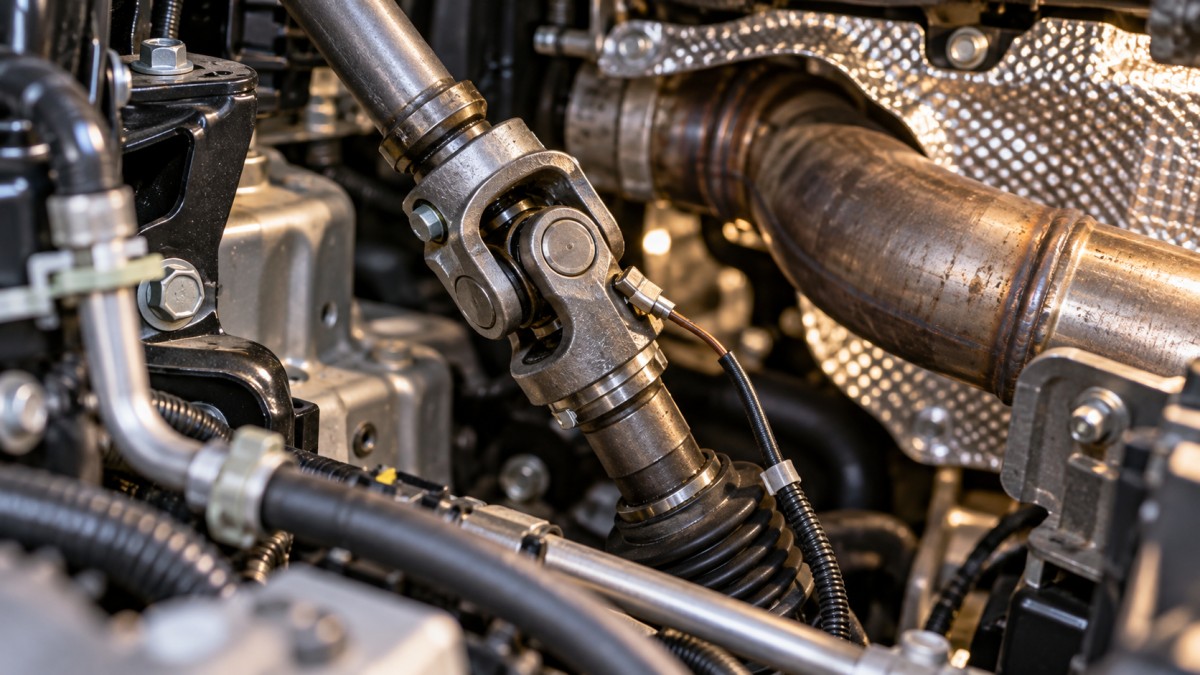
How can you tell whether the universal joint is actually binding?
A tight spot that repeats at particular steering-wheel positions is a useful clue, but not a diagnosis. Bearing damage, joint geometry, column interference, and rack problems can all create position-dependent resistance.
The strongest evidence combines repeatable hot-state symptoms with mechanical isolation of the affected section.
A scan tool cannot directly prove that a mechanical universal joint is healthy. Equally, an absence of diagnostic trouble codes does not exclude an assist-system problem.
What is a reliable hot-versus-cold diagnostic procedure?
Document the conditions before disturbing the assembly
Record ambient temperature, driving duration, steering activity, engine operating state, and whether the problem appears while driving or during subsequent heat soak. Note whether stiffness changes with steering position, direction, vehicle speed, or assist mode.
Distinguish temperature from elapsed time. A complaint after repeated parking maneuvers may involve electric power-steering thermal protection rather than a hot universal joint. A complaint after highway driving followed by a stationary period may point toward local underhood heat soak.
Reproduce the symptom without creating additional risk
If steering catches, requires substantially greater effort, or fails to return normally, avoid further road testing and arrange professional inspection. Reproduction should take place under controlled workshop or proving-ground conditions appropriate to the severity of the fault.
Measure temperatures at relevant locations, including the lower joint and nearby heat sources. Surface readings do not directly equal internal bearing temperatures, but consistent measurement locations help establish a useful comparison. Shiny metal can distort infrared readings, so the measurement method matters.
Compare resistance before the assembly cools
Where the manufacturer provides a procedure, compare steering effort or shaft rotational resistance cold and hot under equivalent conditions. Keep wheel loading, steering position, assist state, and measurement speed consistent.
A hot-only complaint can disappear during disassembly. Plan the inspection sequence in advance so the important measurements occur while the symptom is present.
Isolate the mechanical sections using the prescribed service method
A qualified technician may need to disconnect the intermediate shaft at an approved location to distinguish column-and-shaft resistance from steering-gear resistance. The exact procedure depends on the vehicle.
Secure the steering wheel as specified, observe airbag and electrical precautions, and prevent uncontrolled rotation that could damage the clock spring. Follow requirements for alignment marks, replacement fasteners, tightening, calibration, and post-repair checks. Never drive with the shaft disconnected or incompletely secured.
Once isolated, assess each joint through its intended articulation range. Look for roughness, tight spots, seal damage, corrosion staining, cup movement, and evidence of contact. A joint that frees up after removal may still have been loaded incorrectly in the vehicle.
What other faults can imitate a hot steering universal joint?
Before replacing the shaft, consider how the vehicle generates steering assistance.
In hydraulic systems, hot fluid can reveal internal leakage, reduced pump performance, suction restrictions, or steering-gear faults. Reduced viscosity may decrease available assistance even though the mechanical shaft remains free.
Electric power steering introduces different possibilities: thermal derating, motor or control faults, supply-voltage problems, sensor issues, and mechanical resistance within the assist unit. Diagnostic data should be interpreted against the manufacturer’s operating strategy, not a generic assumption that assistance remains constant.
Column bearings, bulkhead seals, rack friction, and suspension pivot components can also affect steering feel. Changes in road load or alignment may become more noticeable when assistance falls. More than one fault can be present—for example, a corroded joint combined with reduced hot-state assistance.
Will spraying lubricant on the joint solve the problem?
Not reliably. Many steering universal joints are sealed, non-serviceable assemblies. An external spray may not reach the needle bearings at all. A temporary improvement could come from lubricating an external contact point, which does not establish that the internal bearing is repaired.
Unapproved products can affect seals, displace lubricant, attract contamination, or obscure evidence needed for failure analysis. Do not drill a sealed joint, add a grease fitting, or substitute lubricant unless the component manufacturer explicitly permits that service method.
Confirmed bearing binding, significant corrosion, damaged seals, looseness, or cup displacement generally calls for replacement of the specified joint or shaft assembly according to vehicle service information. A replacement part will not correct an unresolved heat-shield, alignment, or installation problem.
How should engineers and quality teams prevent recurrence?
A cold articulation check alone cannot validate a temperature-dependent repair or design change. Testing should cover the vehicle’s relevant thermal conditions, including local heat soak, joint operating angles, mounting tolerances, and realistic environmental exposure.
Useful acceptance evidence includes rotational resistance across temperature, articulation smoothness, seal condition, and performance after appropriate durability and corrosion testing. Apply design-specific limits rather than an arbitrary universal torque threshold.
For recurring production or field complaints, connect failed-part findings with manufacturing and vehicle records. Review bearing-cup installation, yoke dimensions, lubrication controls, seal handling, shaft variants, nearby shielding, and assembly procedures. Preserve returned parts before cleaning or lubricating them so corrosion patterns and lubricant condition remain available for analysis.
The decisive finding is not merely that a steering universal joint becomes hot. It is that a particular thermal condition produces demonstrable friction, interference, or installation load at that location. Establishing that link separates a justified repair from a parts replacement that leaves the original steering complaint unresolved.
Core Sector // 01
Recommended News
 Steering Actuation & ControlWhy Does a Steering Universal Joint Bind Only at High Temperatures?Why does a steering universal joint bind only at high temperatures? Discover heat-related causes, hot-versus-cold diagnostic checks, and repair insights to pinpoint the fault and avoid guesswork.
 Steering Actuation & ControlAre Rubber Steering Couplings Suitable Near High-Temperature Components?Are rubber steering couplings suitable near high-temperature components? Discover how heat exposure, material choice, shielding, and validation guide safer, more reliable selection.
 Steering Actuation & ControlWhy Do Steering Rack Boots Crack Before Their Specified Service Life?Why are steering rack boots cracking before the specified service life? Discover how aging, fitment errors, and chemical exposure cause early failure—and how to prevent it.
 Steering Actuation & ControlWhen does a steering angle sensor need calibration after alignment?When do Steering Angle Sensors need calibration after alignment? Discover key triggers, manufacturer requirements, and verification steps to avoid unnecessary resets and get the job done right.
 Steering Actuation & ControlHow to tell if a power steering pump is failing or drawing in airPower Steering Pumps whining or losing assist? Learn how to spot air leaks, check fluid, and test pump output to avoid unnecessary replacement and make a confident repair decision.
 Steering Actuation & ControlWhat causes power steering fluid to foam after a fluid change?Power Steering Fluid foaming after a change? Discover common causes, safe bleeding tips, and diagnostic steps to restore smooth steering and avoid unnecessary pump replacement.
 Steering Actuation & ControlFinding fluid leaks in hydraulic power steering systemsPower Steering Systems leak diagnosis made clear: learn to trace fluid leaks, identify faulty hoses and seals, and avoid unnecessary replacements with practical inspection tips.
 Steering Actuation & ControlEvaluating steering actuator redundancy for steer-by-wire systemsSteering Actuators for steer-by-wire need more than dual motors. Learn how to assess fault isolation, residual performance, and validation evidence to make safer selection decisions.