Steering Actuation & Control
Navigation
Send Us A Message
Are Rubber Steering Couplings Suitable Near High-Temperature Components?
Author
Date Published
Reading Time
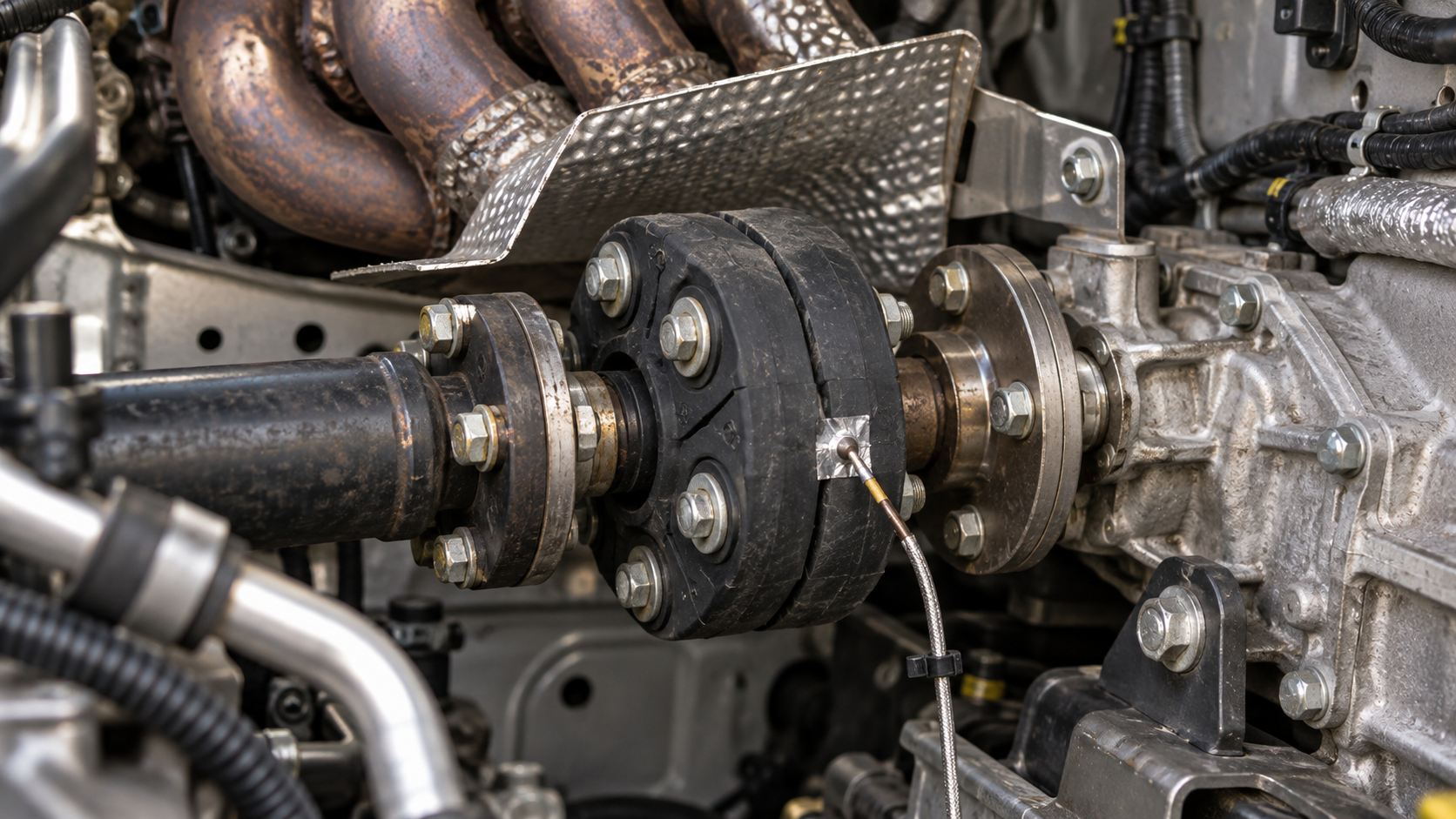
Are rubber steering couplings suitable near high-temperature components? Yes, in some installations—but only when the complete coupling is qualified for the temperature, mechanical loading, and environmental exposure it will actually experience. Distance from an exhaust manifold or turbocharger is not enough to establish suitability. The elastomer compound, exposure duration, shielding, and steering system requirements all matter.
For engineers and sourcing teams, the difficult question is rarely whether rubber can tolerate heat briefly. It is whether the coupling will retain acceptable torque transmission, stiffness, fatigue resistance, and structural integrity throughout its required service life. A component that looks satisfactory during assembly may behave differently after repeated hot shutdowns, fluid contamination, and years of steering reversals.
What makes a rubber steering coupling vulnerable to heat?
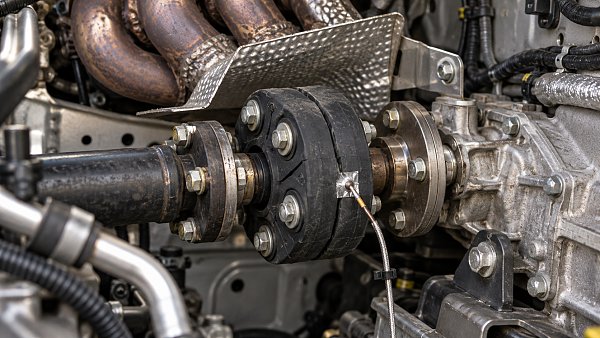
A rubber steering coupling provides a compliant connection within the steering torque path. Depending on its construction, it can reduce vibration transmission and accommodate limited movement or misalignment. Some designs use reinforced flexible discs; others incorporate bonded rubber elements, metal inserts, or different retention arrangements. These constructions should not be treated as interchangeable.
Heat changes elastomer behavior through both immediate and cumulative effects. Temperature can temporarily alter stiffness and damping. Longer exposure can accelerate oxidation, change the crosslink structure, and damage the rubber or its interfaces. Depending on the compound and aging mechanism, the material may harden, soften, lose elongation, or become more susceptible to cracking.
In a steering application, those changes can affect:
- Torsional response: altered compliance can change steering feel and vibration isolation.
- Fatigue durability: aged rubber may resist repeated deformation less effectively.
- Connection integrity: damage around reinforcement, inserts, or bonded surfaces can weaken load transfer.
- Free play: deterioration may contribute to excessive movement, depending on the coupling design.
Visible cracking is therefore not the only concern. A coupling can lose important performance characteristics before obvious external damage appears.
Which temperature matters: the heat source, surrounding air, or coupling itself?
The coupling’s actual temperature history is the essential starting point. Exhaust surface temperature does not equal coupling temperature, and an underhood air measurement may miss a localized hot spot.
Heat reaches the coupling through radiation from nearby surfaces, convection from hot air, and conduction through connected hardware. Direct sight of an exhaust component can produce uneven heating across the rubber. Conversely, a well-positioned shield and adequate airflow may keep the coupling substantially cooler than its surroundings suggest.
Operating conditions also change the picture. Sustained high load, low-speed driving, stationary operation, and engine shutdown can produce different thermal patterns. After shutdown, airflow falls while nearby metal remains hot; the coupling temperature may continue rising for a period even though the vehicle is no longer moving.
A useful thermal survey measures the rubber, relevant metal interfaces, and surrounding conditions across representative worst-case operating modes. Sensor positioning matters: a single reading on an accessible surface may not capture the hottest region. Infrared measurements require attention to emissivity, reflections, and line of sight.
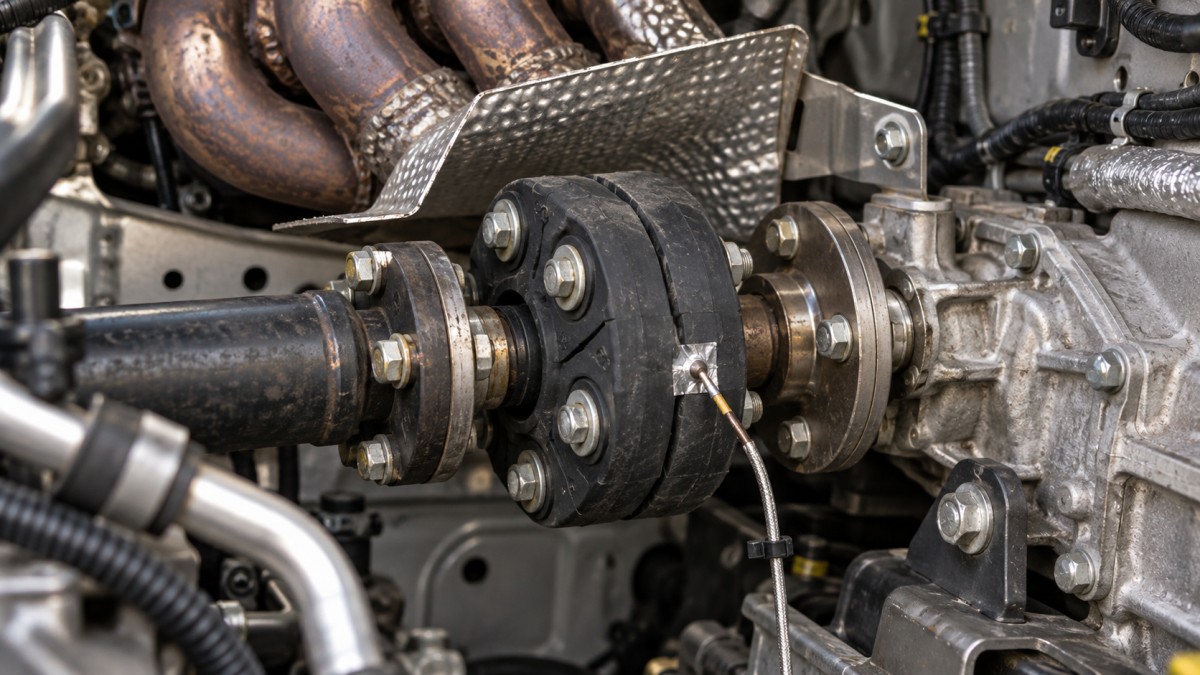
Record peak temperature, time at elevated temperature, heating and cooling rates, and the frequency of exposure. A brief peak and a sustained hot soak should not be treated as equivalent simply because they reach the same maximum reading.
Which rubber materials are suitable for a hot steering installation?
There is no universally suitable “high-temperature rubber” for steering couplings. Material selection must balance thermal aging with tear strength, fatigue behavior, torsional stiffness, damping, fluid resistance, and manufacturability. Reinforcement and bonding systems can be just as important as the base polymer.
This comparison is a screening guide, not an approved-material list. Two compounds from the same polymer family can perform differently because of fillers, cure systems, stabilizers, and processing conditions.
For that reason, a generic temperature range from a polymer datasheet is insufficient. Ask for evidence covering the finished coupling construction, including reinforcement, adhesives, metal preparation, and production curing—not just a rubber test specimen.
Is a supplier’s maximum temperature rating enough to approve the coupling?
No. A temperature rating is meaningful only when its definition is clear. It may describe continuous exposure, a short excursion, an unloaded material test, or performance under a particular set of laboratory conditions.
Before using a rating in a design decision, establish:
- Whether it applies to the elastomer compound or the assembled coupling.
- The permitted exposure duration and number of excursions.
- The mechanical load, deformation, and environmental conditions used during testing.
- The properties measured afterward and the acceptance limits applied.
- Whether the evidence represents production-intent materials and processes.
A coupling that survives a hot-air exposure without visible cracking has not necessarily demonstrated acceptable steering durability. The required evidence should address retained function: torque transmission, torsional stiffness, backlash where applicable, and fatigue performance after aging.
Design margin is also necessary, but it should reflect measurement uncertainty, vehicle variation, manufacturing tolerances, and aging requirements. An arbitrary allowance below a catalog maximum cannot replace that assessment.
Can a heat shield make a rubber steering coupling suitable?
A heat shield can be effective, particularly when radiant heat is the dominant source. Its success depends on placement, coverage, air gaps, surface condition, and mechanical durability—not simply on the presence of a metal barrier.
Shielding should interrupt the important radiation paths without restricting steering movement or interfering with adjacent systems. Engineers also need to consider tolerance stack-up, powertrain movement, vibration, fastener retention, debris accumulation, and service access.
Wrapping the coupling directly is not automatically a better solution. A covering may reduce incoming radiant heat while also limiting cooling or trapping contaminants. Likewise, shielding that works during vehicle motion may perform differently during a stationary hot soak.
Validate the installed arrangement, not the shield in isolation. Repeat temperature measurements after the packaging change, then confirm that the shield remains effective after vibration, corrosion, and relevant durability exposure. If thermal loading remains excessive, rerouting the shaft or increasing separation may be more robust than repeatedly upgrading insulation.
What testing demonstrates reliable performance near high-temperature components?
Validation should connect the measured vehicle environment to the coupling’s safety-related function. The exact program belongs to the vehicle manufacturer and responsible engineering team, but a defensible approach normally includes several linked activities.
Establish baseline mechanical behavior
Measure the characteristics that matter to the application, such as torsional stiffness, hysteresis, rotational free play, torque capacity, and condition of bonded or reinforced regions. Define acceptance criteria before testing rather than interpreting results afterward.
Reproduce thermal aging and environmental exposure
Use the installation’s temperature history to develop appropriate aging and cycling conditions. Include credible contaminants—such as engine oil, grease, road splash, or cleaning agents—where exposure is possible. Heat and chemicals can interact, so separate tests may not reveal every combined effect.
Evaluate durability under representative loading
Assess repeated steering torque reversals, relevant angular displacement, vibration, and any permitted misalignment. Combined thermal and mechanical testing may be necessary where isolated tests fail to represent the service conditions. Accelerated aging methods need justification; excessive test temperature can introduce degradation mechanisms that are not representative of normal service.
Inspect and measure after exposure
Compare aged performance with the baseline. Examine cracking, permanent deformation, bond separation, reinforcement damage, and movement around fasteners or inserts. Confirm that the coupling meets the specified residual functional and strength requirements.
Where a design includes a secondary mechanical torque path or retention feature, its behavior must also be assessed. Such a feature does not make deterioration acceptable, and its presence should never be assumed from appearance alone.
When is a different coupling design the better choice?
A rubber coupling becomes difficult to justify when measured temperatures exceed validated capability, shielding cannot remain effective, or aging produces unacceptable changes in steering behavior. Persistent exposure to incompatible fluids is another reason to reconsider the design.
Alternatives may include a differently positioned flexible coupling, a revised shaft layout, or an appropriate metallic joint arrangement. However, replacing rubber with metal is not a drop-in cure. It can increase vibration transmission, change stiffness, and affect alignment requirements or packaging.
Any redesign must preserve the steering system’s required articulation, torque capacity, retention, and crash-related behavior. The objective is not simply to eliminate rubber; it is to achieve a validated steering connection within the complete vehicle architecture.
What should buyers and quality teams request before sourcing?
For procurement, the useful question is not “Does this supplier offer heat-resistant rubber?” It is “Can this supplier consistently manufacture the coupling construction that passed the application’s validation?”
Request a defined material specification, relevant component test reports, manufacturing controls, and traceability arrangements. Important controls may include compound identification, cure conditions, reinforcement placement, bonding preparation, and dimensional inspection. Clarify how material substitutions, adhesive changes, tooling revisions, and production transfers are approved.
Look closely at the scope of the evidence. A report for another geometry, rubber formulation, or bonding process may support an initial discussion but cannot automatically qualify the proposed part. Production status matters too: prototype success does not by itself demonstrate stable series-production quality.
So, are rubber steering couplings suitable near high-temperature components?
They can be, provided measured exposure remains within the validated capability of the complete assembly and its steering performance remains acceptable after representative aging and loading. Proximity alone neither approves nor disqualifies the design.
The practical decision rests on four things: a credible temperature profile, a compatible coupling construction, durable thermal protection where needed, and application-specific validation. If those are missing, a “high-temperature” material description is not enough—especially for a component in the steering torque path.
Core Sector // 01
Recommended News
 Steering Actuation & ControlWhy Does a Steering Universal Joint Bind Only at High Temperatures?Why does a steering universal joint bind only at high temperatures? Discover heat-related causes, hot-versus-cold diagnostic checks, and repair insights to pinpoint the fault and avoid guesswork.
 Steering Actuation & ControlAre Rubber Steering Couplings Suitable Near High-Temperature Components?Are rubber steering couplings suitable near high-temperature components? Discover how heat exposure, material choice, shielding, and validation guide safer, more reliable selection.
 Steering Actuation & ControlWhy Do Steering Rack Boots Crack Before Their Specified Service Life?Why are steering rack boots cracking before the specified service life? Discover how aging, fitment errors, and chemical exposure cause early failure—and how to prevent it.
 Steering Actuation & ControlWhen does a steering angle sensor need calibration after alignment?When do Steering Angle Sensors need calibration after alignment? Discover key triggers, manufacturer requirements, and verification steps to avoid unnecessary resets and get the job done right.
 Steering Actuation & ControlHow to tell if a power steering pump is failing or drawing in airPower Steering Pumps whining or losing assist? Learn how to spot air leaks, check fluid, and test pump output to avoid unnecessary replacement and make a confident repair decision.
 Steering Actuation & ControlWhat causes power steering fluid to foam after a fluid change?Power Steering Fluid foaming after a change? Discover common causes, safe bleeding tips, and diagnostic steps to restore smooth steering and avoid unnecessary pump replacement.
 Steering Actuation & ControlFinding fluid leaks in hydraulic power steering systemsPower Steering Systems leak diagnosis made clear: learn to trace fluid leaks, identify faulty hoses and seals, and avoid unnecessary replacements with practical inspection tips.
 Steering Actuation & ControlEvaluating steering actuator redundancy for steer-by-wire systemsSteering Actuators for steer-by-wire need more than dual motors. Learn how to assess fault isolation, residual performance, and validation evidence to make safer selection decisions.