Refrigerants & Heat Pumps
Navigation
Send Us A Message
Can automotive refrigerants be mixed during an A/C recharge?
Author
Date Published
Reading Time
Can automotive refrigerants be mixed during an A/C recharge?
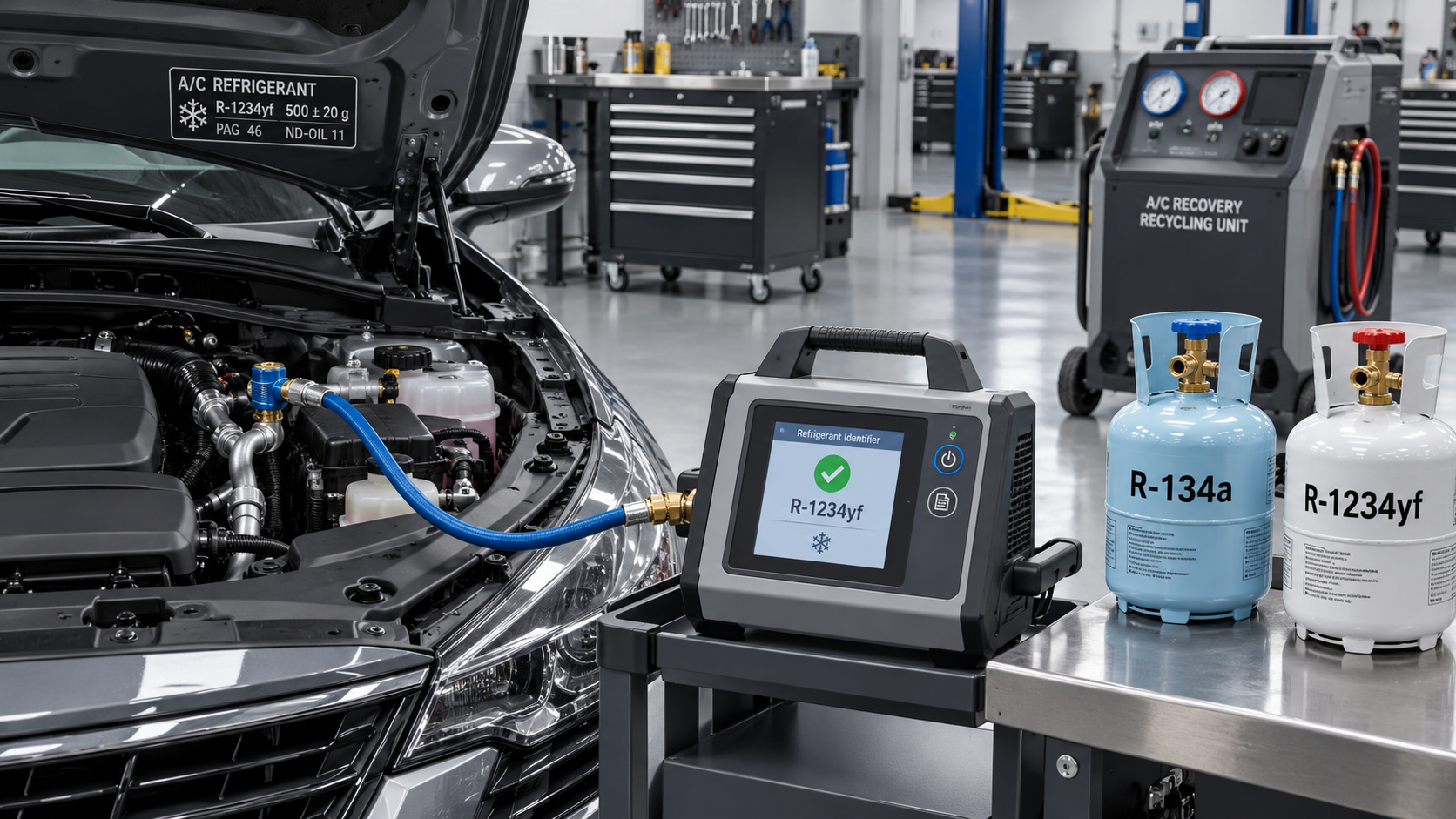
No. Automotive refrigerants should not be mixed during an A/C recharge. Adding R-134a to an R-1234yf system, or using a substitute blend without an approved conversion procedure, can compromise cooling performance, contaminate recovery equipment, and introduce safety or compliance problems. The fact that a refrigerant can circulate through a system does not make it suitable for that system.
For a technician facing weak cooling and an uncertain service history, the immediate job is not choosing a top-up can. It is confirming what the vehicle requires, establishing what is already inside, and deciding whether the shop can safely recover it. Those checks protect both the vehicle and every subsequent job connected to the same service machine.
The underhood label is the starting point—not the whole diagnosis
Read the vehicle’s refrigerant label for the specified fluid and charge mass. Confirm the information against vehicle-specific service data when the label is missing, damaged, or inconsistent with the installed components. Model year alone is not enough: refrigerant transitions differed by platform and market, and older vehicles may have undergone conversions or undocumented repairs.
R-134a and R-1234yf use different service connections to discourage cross-filling. An adapter does not establish compatibility; it defeats a safeguard. A vehicle arriving with an unusual fitting, an aftermarket conversion label, or evidence of improvised charging deserves closer investigation before connection to normal recovery equipment.
Consider a vehicle that began cooling poorly shortly after a do-it-yourself recharge. That history does not prove contamination, but it changes the diagnostic order. Ask what product was added and whether its container is available. “A/C gas” is not a useful chemical identification, and some retail products include oil, dye, sealant, or alternative refrigerants.
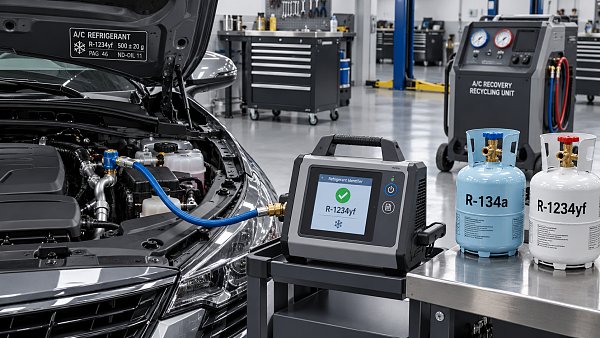
Where contamination is suspected, use an appropriate refrigerant identifier according to its instructions before connecting the main recovery circuit. Some service stations incorporate identification; others require a separate instrument. Confirm that the instrument can evaluate the refrigerant and contamination risks relevant to the job.
Why a mixed charge makes diagnosis unreliable
An automotive A/C system is calibrated around a specified refrigerant, compressor, heat exchangers, expansion device, and control strategy. Refrigerant properties influence evaporation, condensation, mass flow, and compressor operating conditions. Substituting or mixing fluids changes the assumptions behind that calibration.
This is especially troublesome during pressure-based diagnosis. Technicians interpret pressure readings using the expected pressure–temperature relationship of a known refrigerant. With an unknown mixture, that reference may no longer apply. Air contamination can further distort readings by increasing pressure without providing useful refrigeration.
A mixed system may still deliver cool air under light load. That does not validate the charge. Performance can deteriorate as ambient temperature, cabin heat load, or compressor demand increases. Conversely, poor cooling alone does not establish that refrigerants have been mixed: incorrect charge mass, restricted airflow, condenser fouling, and compressor control faults can produce similar complaints.
The practical consequence is wasted diagnosis. If refrigerant identity is uncertain, condemning an expansion valve or compressor from gauge readings alone risks replacing sound components while leaving the underlying problem untouched.
Similar operating pressures do not mean interchangeability
R-134a and R-1234yf can appear sufficiently similar in workshop conversation to encourage shortcuts. They are nevertheless different refrigerants with different servicing and safety requirements. R-1234yf is classified as A2L, indicating lower flammability; R-134a is classified as A1. Mixing them creates an uncontrolled composition, not a validated compromise between the two.
There is also a distinction between a manufactured refrigerant blend and an accidental workshop mixture. A specified blend has a defined composition and servicing requirements. Combining whatever remains in a vehicle with whatever is available in a cylinder does not produce an equivalent product.
Protect the recovery machine before opening its valves
One contaminated vehicle can become a workshop-wide problem if its charge enters the machine’s reusable refrigerant supply. Routine recovery, recycling, and evacuation should not be assumed to separate mixed refrigerants. A filter-drier removes certain contaminants; it does not sort R-134a from R-1234yf.
An identifier’s failed or inconclusive result is therefore a stop point. Follow the instrument and service-equipment instructions rather than repeatedly sampling until a favorable result appears. Check for sampling errors where appropriate, but do not override a rejection simply because the vehicle seems to cool normally.
If contamination is confirmed, recovery requires equipment and a designated container suitable for the actual contents, under the applicable handling rules. Unknown or potentially flammable mixtures may be outside the capability of a shop’s standard equipment. In that case, isolate the job and arrange qualified specialist handling. Do not put suspect refrigerant into the clean recovery cylinder.
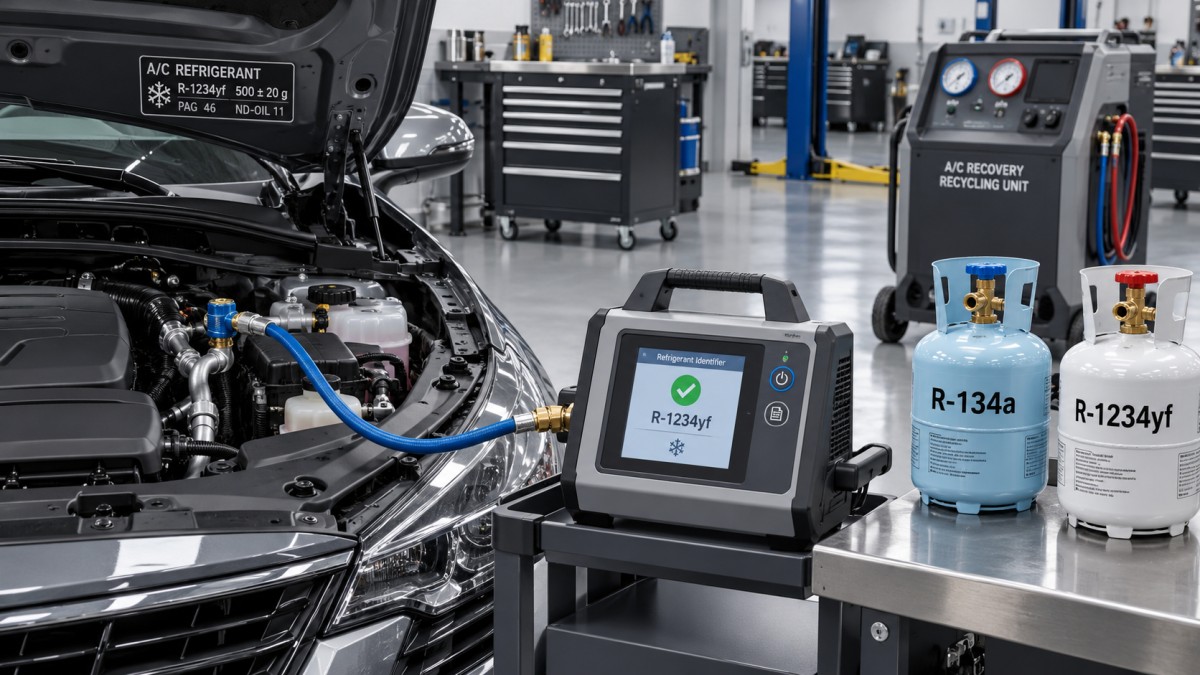
Identify the vehicle’s required refrigerant, assess the existing charge, then select the recovery route. Reversing that order can contaminate equipment before the problem is recognized.
What to do when the wrong refrigerant has already been added
Stop further charging. Do not try to correct the mixture by adding more of the specified refrigerant, and do not deliberately run the system merely to see whether it improves. Record the product added, the estimated quantity if known, and whether the compressor operated afterward. Retain the product packaging or safety data sheet when available.
The next steps depend on what entered the circuit:
- If another refrigerant was added, arrange appropriate recovery of the entire mixed charge. Partial removal cannot reliably restore the specified composition.
- If a hydrocarbon-containing or unidentified product was added, assess flammability and equipment suitability before recovery. Ordinary R-134a equipment must not be presumed suitable.
- If oil or sealant was also introduced, investigate that contamination separately. Removing the refrigerant does not necessarily remove additives left in the circuit.
- If the service machine has already recovered suspect material, stop using its refrigerant supply until the equipment manufacturer’s contamination procedure has been followed.
After recovery, use the vehicle manufacturer’s repair procedure to decide whether additional cleaning, oil correction, or component replacement is necessary. A wrong-refrigerant event does not automatically justify replacing the entire A/C system. Equally, evacuation alone should not be presented as a cure for incompatible oil, sealant, or mechanical debris.
Once the circuit is suitable for service, address leaks and other faults, evacuate as specified, and recharge by the prescribed mass using the correct refrigerant. Verify operation under meaningful conditions, including condenser airflow and compressor control. A cold center vent at idle is useful evidence, but it is not the entire acceptance test.
Oil compatibility and EV thermal systems need separate attention
Correct refrigerant does not automatically mean correct lubricant. Compressor oil requirements are application-specific, including oil chemistry, viscosity, quantity, and electrical properties where relevant. “Universal A/C oil” is not a substitute for checking the compressor and vehicle requirements.
Electrically driven compressors deserve particular care because some designs require lubricant with specific electrical insulating properties. Cross-contamination from service hoses or charging equipment can matter even when the refrigerant itself is correct. Follow the manufacturer’s equipment and oil-handling requirements rather than assuming a process suitable for a belt-driven compressor is suitable for an electric one.
On some EVs and plug-in hybrids, the refrigerant circuit also supports battery cooling or heat-pump operation. A charging error can therefore affect more than passenger comfort. The service procedure may require diagnostic commands, specific valve positions, or additional verification that a conventional recharge routine does not provide.
This system-level relationship is central to GASC’s planned independent coverage of automotive components: compressor selection and servicing cannot be separated from vehicle architecture, thermal loads, and validation requirements. A refrigerant is part of that engineered combination, not an interchangeable workshop consumable.
A top-up, a retrofit, and a compliant repair are different jobs
Adding the same specified refrigerant is not cross-mixing, provided both the existing charge and the supply are suitable and uncontaminated. However, a top-up still leaves uncertainty about total charge mass and why refrigerant was lost. Where service history or charge quantity is unknown, proper recovery and a measured recharge generally provide a more reliable diagnostic baseline.
A retrofit is different again. Historical conversions from R-12 to R-134a do not establish that any two automotive refrigerants can be exchanged. A legitimate conversion needs an applicable procedure addressing components, lubricant, fittings, labeling, charge specification, and legal acceptability. Do not convert an R-1234yf vehicle to R-134a simply because the latter is available or cheaper.
Requirements vary by jurisdiction. In the United States, the EPA’s motor vehicle air-conditioning guidance explains Section 609 servicing requirements and links to refrigerant-specific information. Technician certification, equipment requirements, acceptable substitutes, and venting restrictions should be checked against the actual work proposed. An aftermarket product’s sales description is not evidence that its use is permitted in every vehicle or market.
Before authorizing a recharge, the work order should establish the specified refrigerant, how any identity concern was resolved, and which recovery route was used. If any of those remain uncertain, pause the recharge. Resolving that uncertainty is usually a smaller job than decontaminating the recovery station and revisiting vehicles serviced afterward.
Core Sector // 01
Recommended News
 Refrigerants & Heat PumpsWhere Should a Cabin Humidity Sensor Be Placed?Cabin humidity sensor placement affects comfort and fog prevention. Learn where to mount sensors, avoid misleading readings, and optimize HVAC performance.
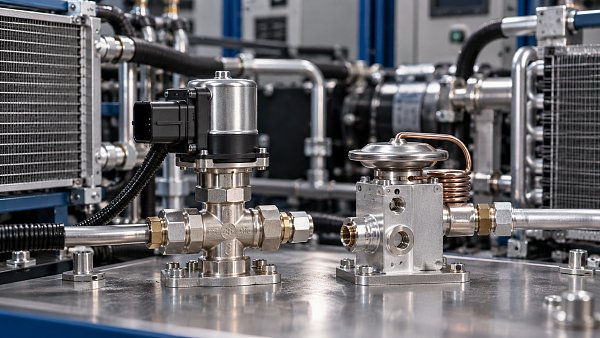
 Refrigerants & Heat PumpsElectronic vs. Thermal Expansion Valves: Which Should You Choose?Electronic vs thermal expansion valve: compare control, cost, and efficiency for vehicle A/C and heat pumps. Discover which option best fits your system.
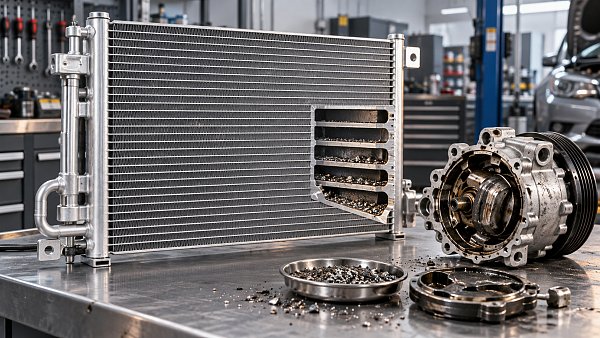
 Refrigerants & Heat PumpsWhen does compressor failure require replacing the car A/C condenser?Automotive A/C Condensers don't always need replacing after compressor failure. Learn when debris or damage demands replacement—and avoid costly repeat repairs.
 Refrigerants & Heat PumpsCan Global Automotive Systems & Components Portal Help Compare EV Heat Pump Refrigerants?Can Global Automotive Systems & Components Portal help compare refrigerants for EV heat pumps? Explore R1234yf, R744 and R290 trade-offs in efficiency, safety and cost to build your shortlist.
 Refrigerants & Heat PumpsCan automotive refrigerants be mixed during an A/C recharge?Can Automotive Refrigerants be mixed during an A/C recharge? Learn why mixing is risky, how to identify contamination, and what to do to protect your vehicle and service equipment.