Refrigerants & Heat Pumps
Navigation
Send Us A Message
Electronic vs. Thermal Expansion Valves: Which Should You Choose?
Author
Date Published
Reading Time
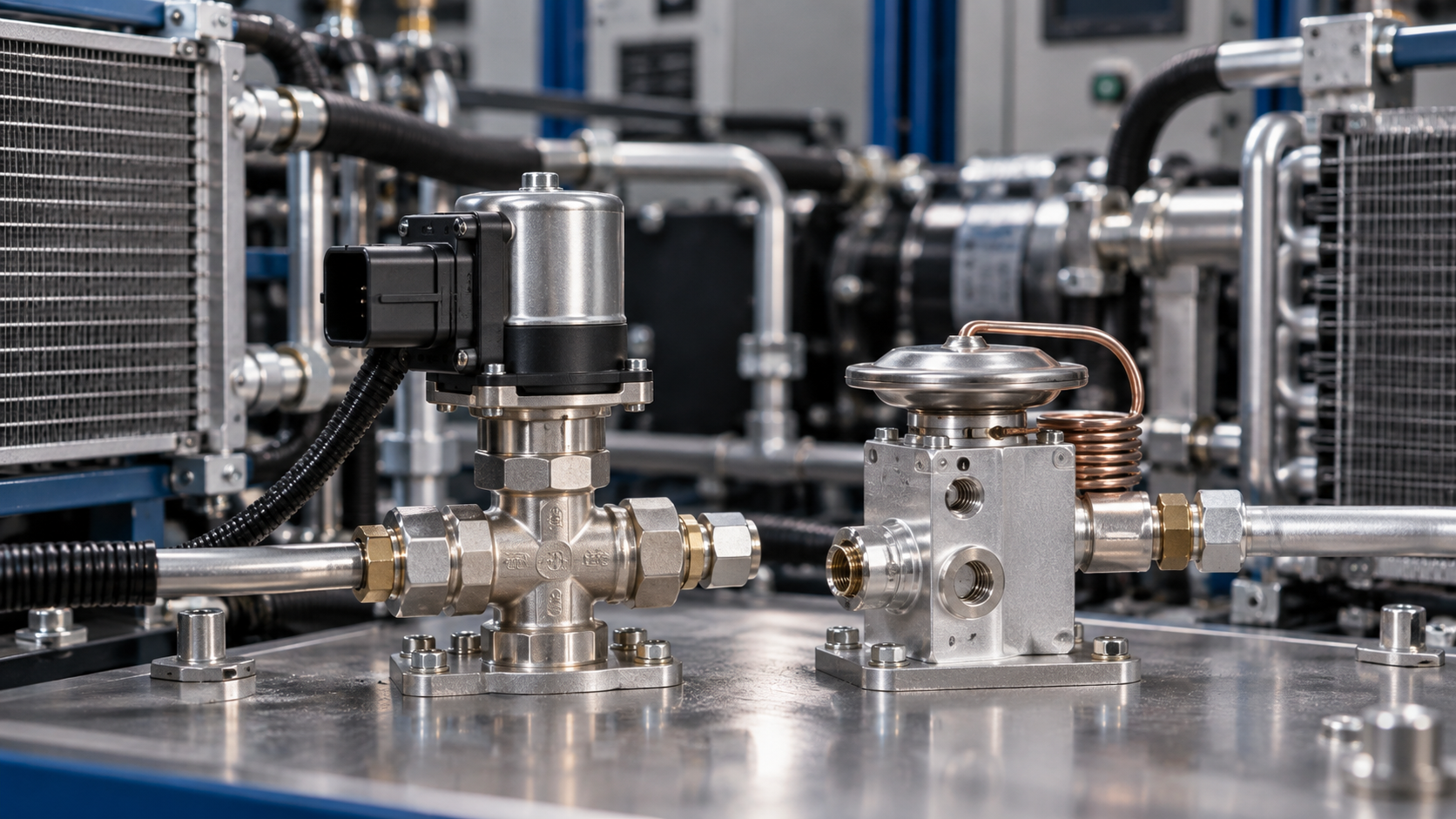
Choose an electronic expansion valve when the refrigerant circuit needs adjustable control across changing loads, multiple cooling branches, or heat-pump operating modes. Choose a thermostatic expansion valve when a relatively simple A/C circuit can meet its performance targets with mechanical superheat regulation. The better choice depends on the complete system, including its compressor, sensors, control software, and operating range.
The electronic vs thermal expansion valve comparison therefore starts with what the vehicle needs to do. An electronic valve offers greater control flexibility, but realizing that benefit requires sound integration and calibration. A thermostatic valve reduces electronic dependencies, but its mechanical response may limit performance in more complex thermal systems.
What changes when refrigerant control becomes electronic?
Both valve types meter refrigerant entering an evaporator. By restricting flow, they create the pressure drop that allows refrigerant to evaporate at a temperature suitable for cooling. Their main difference is how they decide how far to open.
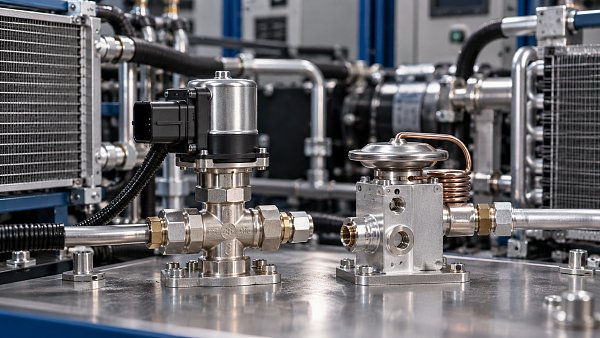
A thermostatic expansion valve, commonly abbreviated TXV or TEV, responds mechanically to conditions at the evaporator outlet. “Thermal expansion valve” is a common search term, although thermostatic expansion valve is the more precise name.
In a conventional TXV, a temperature-sensitive charge produces pressure that acts against evaporator pressure and a spring force. This balance adjusts the valve opening to regulate outlet superheat. Some designs use an external sensing bulb; automotive block valves commonly integrate temperature sensing into the valve assembly.
Superheat is the amount by which refrigerant vapor temperature exceeds its saturation temperature at the measured pressure. It helps indicate whether refrigerant has finished evaporating before leaving the evaporator. Excessive superheat can indicate an underfed evaporator, while insufficient superheat can increase the risk of liquid reaching the compressor.
An electronic expansion valve, or EEV, uses an electrically driven actuator to position the opening. A controller commonly calculates superheat using pressure and temperature measurements, then commands the valve. Depending on the system architecture, it can also coordinate refrigerant flow with compressor speed, cooling demand, and operating mode.
This distinction matters: a TXV mechanically regulates around its designed characteristics, while an EEV allows the control strategy to change with operating conditions. Electronic actuation alone does not guarantee accurate refrigerant control; sensor quality, valve sizing, and software determine the result.
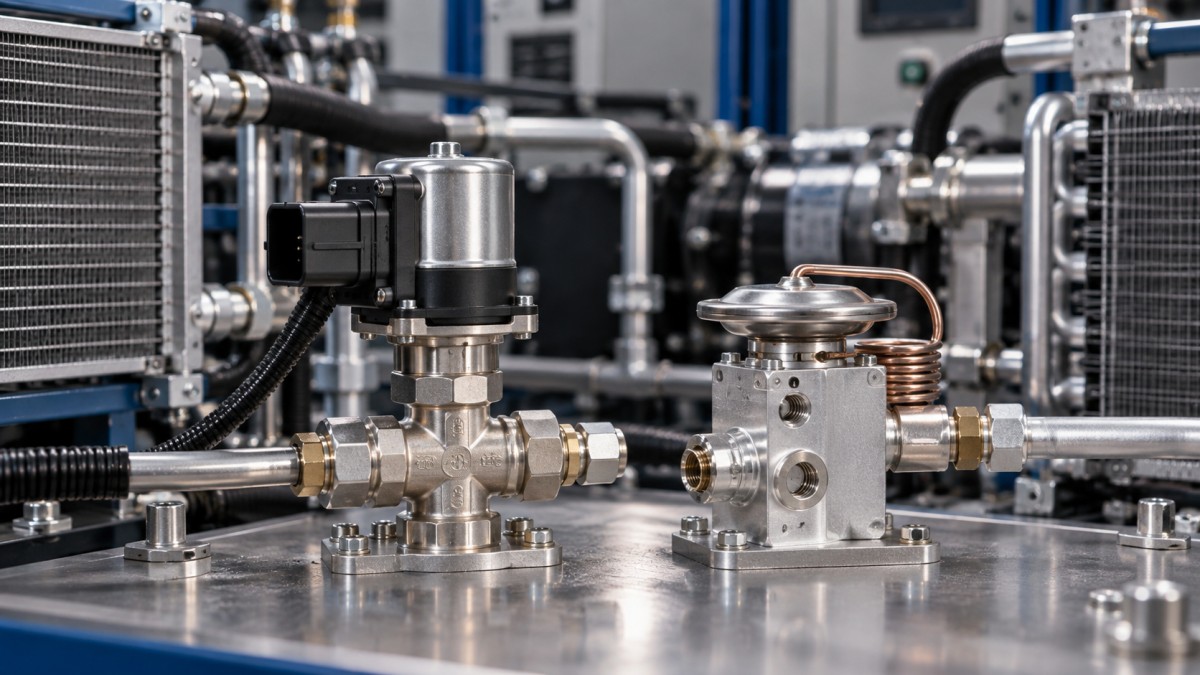
Electronic vs. thermostatic expansion valves: practical differences
Neither valve directly determines cabin comfort or efficiency by itself. Airflow, heat exchanger sizing, compressor control, refrigerant charge, and condenser performance can outweigh the difference between two otherwise suitable valves.
When a thermostatic expansion valve is the better fit
A TXV is a strong candidate for a conventional cabin A/C circuit with a well-understood load range and limited need to change its refrigerant-control strategy. If a matched valve delivers acceptable cooling, stable superheat, and compressor protection across the required conditions, adding electronic control needs a measurable justification.
Mechanical regulation can also simplify a program that has limited controller capacity or software development resources. There is no valve actuator driver or electronic valve-control algorithm to integrate, although the wider A/C system still requires appropriate compressor and protection controls.
The practical boundary is the operating envelope. A TXV selected around one design condition may behave less effectively at very low load, during rapid compressor-speed changes, or across large pressure variations. That does not make TXVs unsuitable for variable-capacity systems; it makes matching and validation essential.
For an existing platform, retaining a proven TXV can be sensible when thermal requirements remain similar. However, changing the refrigerant, compressor, evaporator, or circuit layout can alter the valve’s suitability. Carryover should follow a performance assessment rather than a decision based only on familiar packaging.
Where an electronic expansion valve earns its added complexity
An EEV becomes more attractive when one mechanical calibration cannot adequately serve the required operating conditions. Its value comes from the ability to coordinate refrigerant flow with the rest of the thermal system.
Wide compressor-speed and load ranges
An electrically driven compressor can operate across substantially different speeds and cooling demands. An EEV allows the controller to adjust refrigerant metering as these conditions change, potentially keeping more evaporator surface active while maintaining an appropriate superheat margin.
That benefit depends on control stability. Aggressive valve movements can produce oscillations in pressure and superheat, especially when compressor and valve controllers react to each other. A fast actuator is useful only when the complete control loop responds appropriately.
Battery cooling alongside cabin cooling
When a refrigerant circuit serves both a cabin evaporator and a battery chiller, the branches may need different refrigerant flows at the same time. Cabin demand can fall while battery cooling remains necessary during charging or high-load driving.
Electronic metering can support controlled allocation between branches, but the valves must be coordinated with shared compressor capacity and system pressures. Installing independently controlled valves without managing their interaction can cause unstable flow distribution or leave one branch short of capacity.
Heat-pump operation and mode transitions
Vehicle heat pumps introduce operating modes with different refrigerant paths and heat exchanger duties. Electronic valves can support mode-dependent metering and transition strategies, making them useful in these architectures.
However, an EEV is not automatically suitable for every flow direction or pressure condition. The circuit may require bidirectional metering, check valves, dedicated shutoff valves, or separate expansion devices. A metering valve should not be assumed to provide leak-tight isolation unless its specification supports that function.
Efficiency gains must be demonstrated at system level
Electronic expansion valves can improve efficiency when their control flexibility reduces avoidable compressor work or improves evaporator utilization. The benefit depends on how much the original system’s performance was constrained by refrigerant metering.
If a TXV already controls the evaporator effectively over most operating conditions, replacing it with an EEV may deliver only a modest improvement. If the system frequently operates outside the TXV’s best range, electronic control may offer more value.
Compare energy consumption while delivering equivalent cabin and battery temperature performance. Lower compressor power is not a useful improvement if cooling capacity also falls below the requirement. For an EV, the assessment should include the relevant cabin, battery-conditioning, charging, and heat-pump operating modes.
Avoid treating the lowest possible superheat as the target in every condition. Reducing superheat can improve evaporator utilization, but sufficient margin is needed for sensor uncertainty, refrigerant distribution, and transient liquid carryover. The appropriate target depends on the circuit and compressor requirements.
Check these requirements before comparing supplier quotations
Valve selection should begin with the operating envelope. Nominal cooling capacity alone does not describe how a valve will behave during startup, low-load operation, or a change in thermal mode.
- Refrigerant and lubricant compatibility: Specify the refrigerant, oil, seals, materials, and pressure requirements together. A valve intended for one refrigerant system is not automatically transferable to another.
- Flow range and pressure differential: Check maximum required flow and controllability at the lowest useful flow. An oversized valve can struggle to meter small quantities consistently.
- Flow direction and leakage: Define reverse-flow requirements and allowable closed-valve leakage separately from metering performance.
- Packaging and durability: Assess connections, mounting loads, vibration, temperature exposure, corrosion, and service access.
- Control interfaces: For an EEV, establish actuator-drive requirements, sensor inputs, position initialization, and diagnostic behavior.
For a TXV, sensing conditions also deserve attention. Poor bulb contact in an external-bulb design, unsuitable mounting, or an incorrect pressure-equalization arrangement can undermine regulation. For integrated automotive valves, correct installation and the intended refrigerant passages remain essential.
For an EEV, determine whether the system measures valve position or estimates it from actuator commands. Some designs require a homing procedure to establish a reference position. Commanded position does not necessarily prove that the valve has physically moved or that refrigerant is flowing as expected.
Reliability includes faults, contamination, and service
A TXV avoids actuator-driver and valve-control software faults, but it can still suffer from contamination, sticking, sensing-charge loss, or mechanical deterioration. An EEV adds electrical and software dependencies while potentially providing better diagnostic visibility. Reliability depends on design and manufacturing quality as well as component count.
For an electronic valve, specify what happens after power loss, a disconnected sensor, a stalled actuator, or invalid pressure data. An EEV should not be assumed to close when power disappears; its behavior depends on actuator design and available mechanisms. The system may need to stop the compressor or enter another protective state.
Cleanliness matters for both technologies. Debris can obstruct the metering opening or prevent proper seating. Moisture control, filtration, assembly cleanliness, and refrigerant-service practices therefore belong in the selection discussion.
Serviceability changes too. Replacing an electronic valve may require initialization, diagnostic equipment, or a defined software procedure. Replacing a thermostatic valve still requires the correct application specification; a physically compatible part may have unsuitable metering characteristics.
Make the decision with a representative validation plan
Use a TXV as the starting candidate when the circuit is straightforward and mechanically regulated superheat can satisfy the required envelope. Give an EEV serious consideration when variable loads, shared cooling branches, or heat-pump modes require active coordination.
Then compare candidates using the same refrigerant charge strategy, cooling targets, and representative operating conditions. Include hot-soak cabin pull-down, low-load operation, compressor-speed changes, and any relevant battery-cooling or heating transitions. Evaluate temperature control, superheat stability, energy use, noise, and fault response together.
Commercial comparisons should include sensors, drivers, wiring, calibration, validation, diagnostics, and service requirements alongside valve price. An electronic valve can justify its cost when it solves a demonstrated control problem. A thermostatic valve remains a sound choice when its simpler regulation meets the vehicle’s requirements throughout the intended operating range.
Core Sector // 01
Recommended News
 Refrigerants & Heat PumpsWhere Should a Cabin Humidity Sensor Be Placed?Cabin humidity sensor placement affects comfort and fog prevention. Learn where to mount sensors, avoid misleading readings, and optimize HVAC performance.
 Refrigerants & Heat PumpsElectronic vs. Thermal Expansion Valves: Which Should You Choose?Electronic vs thermal expansion valve: compare control, cost, and efficiency for vehicle A/C and heat pumps. Discover which option best fits your system.
 Refrigerants & Heat PumpsWhen does compressor failure require replacing the car A/C condenser?Automotive A/C Condensers don't always need replacing after compressor failure. Learn when debris or damage demands replacement—and avoid costly repeat repairs.
 Refrigerants & Heat PumpsCan Global Automotive Systems & Components Portal Help Compare EV Heat Pump Refrigerants?Can Global Automotive Systems & Components Portal help compare refrigerants for EV heat pumps? Explore R1234yf, R744 and R290 trade-offs in efficiency, safety and cost to build your shortlist.
 Refrigerants & Heat PumpsCan automotive refrigerants be mixed during an A/C recharge?Can Automotive Refrigerants be mixed during an A/C recharge? Learn why mixing is risky, how to identify contamination, and what to do to protect your vehicle and service equipment.