Vehicle Heat Pumps
Navigation
Send Us A Message
Using powertrain waste heat in EV thermal management systems
Author
Date Published
Reading Time
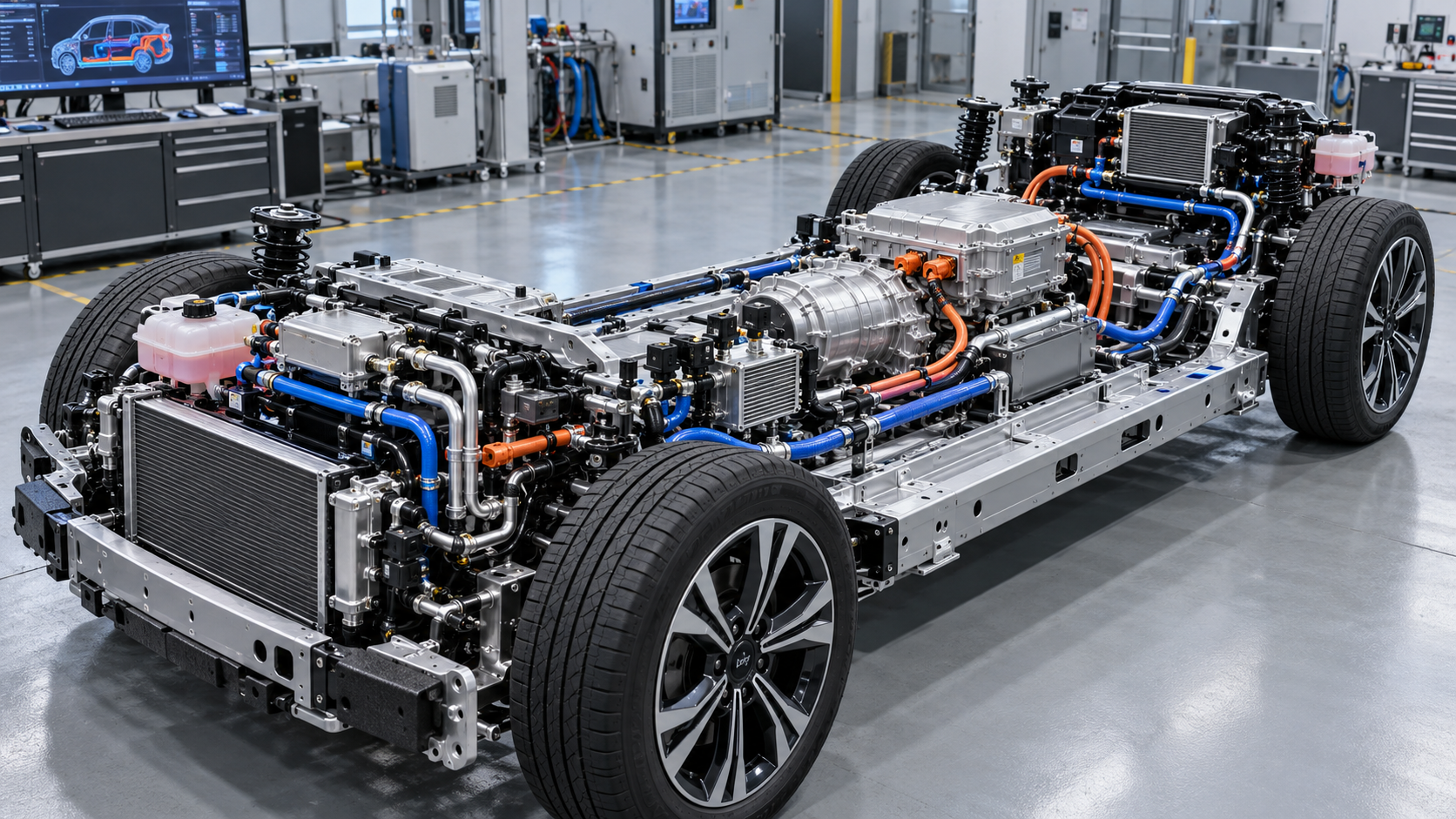
Powertrain waste heat can reduce the battery energy used for cabin heating when an electric vehicle produces enough recoverable heat at a useful temperature. Its value is strongest during sustained operation, when motor, inverter, and drivetrain losses coincide with heating demand. A cold vehicle starting a short trip presents a harder case: the cabin needs heat immediately, while the powertrain may have little available to supply.
For project leaders evaluating EV thermal management systems, the decision therefore starts with the vehicle’s operating profile. A recovery system must deliver an energy benefit across representative journeys while preserving component temperature limits, cabin comfort, and battery conditioning. Added valves, heat exchangers, plumbing, and software need to earn their place through measurable vehicle-level savings.
Establish when usable heat actually exists
Motors and inverters generate heat through electrical and mechanical losses. Where a vehicle uses liquid cooling, some of that energy enters a coolant circuit and can potentially serve another thermal load. Recoverable heat is only a portion of total component losses: some escapes through housings and surrounding structures, and some cannot be extracted without compromising component temperature control.
Two characteristics determine whether this heat is useful: its rate of production and its temperature. A coolant circuit can contain substantial thermal energy yet remain too cool to heat cabin air effectively through a conventional heater core. Conversely, a suitably warm source may provide insufficient continuous output to meet demand. A thermal architecture must address both conditions.
Heat availability also changes throughout a journey. Higher traction loads can increase losses, but vehicle speed, ambient temperature, cooling airflow, and component efficiency affect the resulting coolant temperature. Rated motor power alone is a poor basis for estimating heating capability.
The operating cases below deserve separate treatment in the vehicle energy model:
- Cold soak followed by a short trip: Cabin heating demand arrives before much powertrain heat accumulates. Supplemental heating may dominate the journey.
- Sustained driving in cold weather: Continuous losses can provide a useful heat source, although road load and heating demand still need to be matched.
- Urban operation with long stops: Traction heat production can fall while cabin heating continues. The controller must bridge the mismatch without unstable temperature delivery.
- High-load operation: More heat may be available, but motor and inverter protection must retain priority. Recovery cannot restrict required cooling.
A useful early deliverable is a time-based heat balance for each priority route. It should show cabin demand, battery conditioning demand, recoverable source heat, source temperature, and supplemental electrical heating. Journey totals alone can hide a shortage during the first minutes, precisely when comfort and windshield clearing requirements are most demanding.
Choose the heat path around the temperature gap
There are two principal ways to use recovered powertrain heat: transfer it through coolant to a heating load, or feed it into the low-temperature side of a heat pump. These approaches can coexist, but they have different operating limits and integration costs.
Direct coolant heat transfer
Direct recovery uses sufficiently warm coolant to support cabin or battery heating. Depending on the layout, this can involve a shared coolant path or a liquid-to-liquid heat exchanger separating circuits. It avoids the need to raise the recovered heat’s temperature through a refrigeration cycle, although pumps and other auxiliaries still consume energy.
The constraint is the temperature difference across the heat exchanger. Delivering useful cabin heat requires a source temperature high enough for the required air outlet temperature and heat transfer rate. A warm drivetrain circuit may help preheat a cold battery while offering limited cabin heating performance under the same conditions. Component specifications should therefore be evaluated against actual inlet temperatures and flows.
Raising powertrain coolant temperature solely to improve cabin heating also requires scrutiny. Motor windings, magnets, bearings, inverter power devices, and other affected parts have their own limits. A shared circuit is viable only where the permitted temperature ranges and control requirements are compatible.
Heat-pump-assisted recovery
A heat pump can draw energy from powertrain coolant through a refrigerant-to-coolant heat exchanger and deliver heat at a higher temperature to the cabin or another load. This extends the usefulness of heat that is too cool for direct cabin heating. Depending on architecture and conditions, powertrain coolant may supplement or replace ambient air as a heat source.
The benefit depends on the complete refrigeration operating point. Source temperature, required delivery temperature, compressor efficiency, refrigerant pressure losses, and heat exchanger performance all affect electrical consumption. Recovering more heat does not automatically produce a proportional reduction in battery draw.
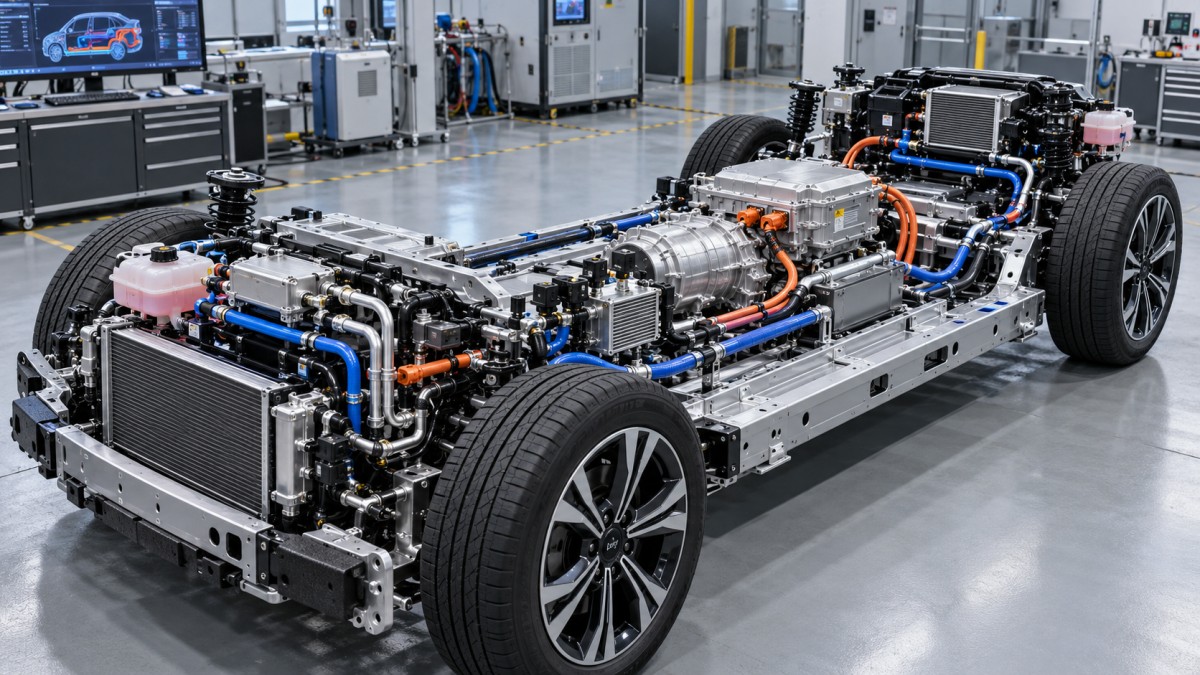
A system schematic should make the operating modes visible: where heat leaves the powertrain loop, how it reaches the refrigerant circuit or heating load, and how it is rejected when heating is unnecessary. It should also identify bypasses and the fallback cooling path. Those details reveal whether recovery adds flexibility or creates a dependency between functions that must remain available independently.
For a platform already equipped with a heat pump, adding a powertrain heat source may require a different investment from introducing a heat pump into a vehicle built around resistance heating. The business case needs the actual starting architecture, including packaging space, existing heat exchangers, and available control interfaces.
Measure the saving across the whole vehicle
The relevant result is the reduction in battery energy needed to complete an equivalent journey with equivalent cabin comfort and battery conditions. Recovered thermal energy is useful diagnostic information, but it is not the final measure of success.
A recovery configuration can reduce electric heater demand while increasing pump or compressor consumption. Additional heat exchangers can introduce pressure drop, and longer coolant paths can require more pumping power. Extra coolant and hardware also add thermal mass, potentially changing warm-up behavior. These effects belong in the comparison.
Use a defined baseline. Compare recovery enabled and disabled, or compare alternative architectures, under matched ambient conditions, soak temperatures, drive cycles, occupancy assumptions, and comfort targets. If one configuration delivers a colder cabin or finishes with a colder battery, the apparent energy saving may simply reflect reduced thermal service.
Battery heating makes the accounting more complicated. Directing powertrain heat toward the pack can support temperature-dependent performance or charging objectives, but it may leave less heat for the cabin. The benefit depends on the departure schedule, subsequent charging event, and battery control strategy. Heat allocation therefore needs an explicit priority policy.
Grid-connected preconditioning should be included where it forms part of the intended use case. Preheating the cabin and battery can change both the initial thermal state and the heating demand during driving. Report driving energy separately from preconditioning energy so that the comparison remains clear.
A practical assessment should answer three questions:
- How much net battery energy does recovery save on the routes and weather conditions that matter to the program?
- How often is recovery available, and how much supplemental heating remains necessary?
- What additional cost, mass, packaging, and validation effort does each architecture require to achieve that saving?
A single favorable cold-weather operating point is insufficient for a platform decision. Short urban trips, longer regional journeys, and sustained high-load operation expose different constraints. Weighting these cases against the intended duty cycle produces a more useful investment basis than selecting the highest recovery result.
Integration succeeds through control and validation
Thermal controls determine whether the hardware delivers its predicted benefit. The controller must manage changing heat sources and competing demands while keeping component temperatures within limits. It also needs to avoid frequent switching that creates cabin temperature fluctuations, excessive actuator activity, or inefficient compressor operation.
Consider a vehicle that leaves a high-load road segment and stops in traffic. Powertrain heat production falls, cabin demand persists, and coolant retains some stored energy. A controller responding only to instantaneous temperature may continue extracting heat until the source becomes unsuitable, then call abruptly for supplemental heating. Using available vehicle signals to anticipate demand can improve the transition, but the strategy still needs a stable fallback when predictions are wrong.
Mode transitions deserve explicit acceptance criteria. These include cold start, recovery activation, changing heat allocation between cabin and battery, entry into high-load cooling, and loss of a heat source. Windshield clearing and visibility requirements must remain achievable when recovered heat is unavailable. Removing supplemental heating capacity is a separate engineering decision requiring evidence across the full operating envelope.
Component selection should follow these operating modes. For heat exchangers, assess performance across the expected temperature differences, coolant mixtures, flow rates, and refrigerant conditions. Include pressure drop and the consequences of an internal leak. A nominal heat transfer rating at favorable conditions gives little assurance about performance with a cold source.
For pumps and valves, check controllable flow range, leakage between ports, response time, electrical consumption, and behavior at low coolant temperature. Valve leakage can create unintended heat paths, warming a circuit that should remain isolated or cooling one that needs heat. Sensor placement also matters: a convenient temperature measurement may poorly represent the fluid entering a heat exchanger during a transition.
Validation should connect thermal performance with fault behavior and serviceability. A stuck valve, degraded pump, implausible sensor reading, or trapped air pocket can affect several functions in an integrated system. Teams need to establish which faults reduce heating capability, which threaten component cooling, and how the vehicle detects and manages each condition.
Physical layout can undermine an otherwise sound concept. Long hoses increase coolant volume and heat loss; restrictive routing raises pumping demand; difficult venting can leave air in high points. Filling, bleeding, draining, and replacing components should be reviewed before packaging is frozen. These details influence both production consistency and whether field repairs restore the intended performance.
The strongest program gate is a demonstrated net energy benefit on representative journeys, supported by acceptable comfort, reliable cooling, and manageable integration cost. If the benefit appears mainly after prolonged high-load driving while the target vehicle spends its life on short cold trips, the architecture deserves reconsideration. If useful source heat consistently overlaps with demand and fits the existing thermal layout, powertrain recovery can justify its added complexity. The decision should follow that overlap, with enough operating margin to survive the journeys that are less favorable.
Core Sector // 01
Recommended News
 Vehicle Heat PumpsUsing powertrain waste heat in EV thermal management systemsEV Thermal Management Systems can recover powertrain waste heat to reduce heating energy use. Explore heat paths, controls, and real-world savings to make smarter design decisions.
 Vehicle Heat PumpsWhen do automotive heat pump systems need backup heating?When do Automotive Heat Pump Systems need backup heating? Explore cold starts, defrost demands, and heater sizing to select the right solution for reliable comfort and visibility.